The Minnesota Rule for Riders Born After 1987
Minnesota’s birthdate rule can be confusing because it is tied to a specific cutoff, not simply to whether you were born sometime after 1987. It also gets mixed up with ATV registration and trail-pass requirements. This guide explains who needs safety certification, when it applies, what young riders must consider, and how the rule works for visitors and out-of-state certificates.
What the Minnesota birthdate rule means
The cutoff is July 1, 1987
Minnesota generally requires ATV safety certification for riders born after July 1, 1987, when they operate an ATV in covered public settings. That means the exact date matters: someone born on July 1, 1987, is not in the same birthdate group as someone born the next day. If your birthday falls close to the cutoff, check the date on your identification rather than relying on a rough recollection of the rule.
The phrase “born after 1987” is a common shorthand, but it can be misleading. The rule is not simply “anyone born in 1988 or later.” A person born during the second half of 1987 may also fall within the group required to complete training. That is why riders often search for The July 1987 Birthdate Rule before a trip, especially when a family member’s birthday is near the cutoff.
A practical example: imagine two adults riding together on a Minnesota public trail. One was born in June 1987 and the other in August 1987. Their ages may be nearly identical, but the certification requirement can differ because of their birthdates. If you are unsure whether the cutoff applies to you, resolve that question before heading to a trailhead rather than hoping the distinction will not come up during a check.
The rule concerns certification, not a general riding permit
Safety certification is proof that a rider completed the required ATV safety training. It is not the same thing as registering a machine, buying a trail pass, or getting permission to use a particular route. These are separate requirements, and one does not automatically replace another.
It helps to think of a Minnesota ride as having several independent “checks.” The machine may need the proper registration for its use, the rider may need training certification based on age and where they ride, and a trail pass may be needed for certain trail systems. A machine can be properly registered while its operator still needs certification. Likewise, a certified rider can still be missing a required pass.
This distinction matters most when people are preparing quickly. Someone may renew the ATV registration, see a current decal on the machine, and assume the paperwork is complete. But registration is about the machine’s record and use, while certification is about the rider’s training. For a broader explanation of the training requirement, see Minnesota’s ATV Safety Training Requirement and Minnesota ATV Safety Training Requirements.
The place where you ride matters
The birthdate-based training requirement is associated with operating in covered public settings, including public lands and public riding areas. A trail ride, a public riding area, and a short trip along a public right-of-way can raise different questions from riding entirely on private property with permission. The exact rules can depend on the location, the rider’s age, the machine, and the type of access.
That does not mean private property is automatically a rule-free zone. Landowner permission, local restrictions, age-related requirements, safe operation, and other laws can still matter. A private field may also connect to a public trail or road crossing, so a ride that begins on private ground can eventually enter a setting where certification or other requirements apply.
If your planned route crosses between a cabin property, a forest trail, a public road right-of-way, or a state-managed riding area, plan for the most demanding part of the route. Do not assume that the rules for the driveway or field continue unchanged once you enter a public area. The specific route and land manager can make a difference, so check the relevant requirements before riding.
Who needs ATV safety certification in Minnesota
Adults born after the cutoff
For an adult born after July 1, 1987, certification is an important pre-ride item when operating an ATV in covered public settings. Being an experienced rider does not necessarily substitute for the required credential. Years of operating a quad on family land may help you handle the machine, but they do not automatically show that you completed an approved safety course.
This can surprise riders who learned informally as teenagers or have used a machine for farm chores for years. They may be confident with throttle control, braking, and basic recovery, yet still need to complete formal training before using public trails. The practical approach is to check the rule based on your date of birth and riding location, then complete any required training before the trip.
The requirement is about the operator, not just the owner. If your spouse, friend, or adult child takes the handlebars, that person’s own birthdate and certification status matter. A registration document in your name does not transfer your training credential to another rider. For the wider question of who is covered, consult Who Must Certify to Ride Minnesota Public Land.
Young riders have additional considerations
A rider’s birthdate is only one part of the picture for children and teenagers. Minnesota’s youth riding rules can involve minimum ages, the machine being operated, the type of land or route, safety certification, and adult supervision. A young rider may need to meet several requirements at once, so parents should avoid treating a completed course as a blanket permission to ride anywhere.
For example, a teen may have completed safety training but still need to follow age-specific restrictions or ride under the required supervision. The rules may also differ depending on whether the teen is operating a machine on a trail, crossing a road, riding on private property, or using a machine with different passenger or size characteristics. The rider’s confidence and physical ability matter too, even when paperwork is in order.
Families often find it useful to check requirements as a child approaches an age milestone. Rules applicable to a 12-year-old may not be identical to those for a 15-year-old or a rider who has turned 16. Before changing the route or allowing a teen to ride independently, review Minnesota Age Rules for Young Riders and [Minnesota Rules for a Rider Turning 16]. Keep supervision and machine suitability in the conversation, not just the certificate.
Visitors and riders with certificates from another state
A visitor does not become exempt from Minnesota’s rider requirements just because the machine is registered elsewhere. If you are traveling from Wisconsin, Iowa, North Dakota, or another state, check both the certification rules and the trail-access requirements for the places you intend to ride. Home-state paperwork can be relevant, but it does not guarantee that every Minnesota requirement has been met.
Out-of-state safety credentials may be accepted in some circumstances, but do not assume that a wallet card, online completion screen, or certificate from a different program will automatically satisfy Minnesota’s requirements. Confirm that your particular credential is recognized and that you can show proof in the form expected. If the document is digital, make sure you can access it where you are riding; cell service can be unreliable in parts of northern Minnesota.
The same caution applies to visitors who have ridden for years without taking a course because their home state handles training differently. A trip to a Minnesota trail system is a good time to check the state’s rules in advance, rather than sorting it out at a staging area. See Out-of-State Certificates Minnesota Accepts and Minnesota Rules for Visiting Riders when preparing a cross-border ride.
How certification fits with passes and registration
Certification does not replace machine registration
A safety certificate belongs to the rider; registration applies to the machine. If you own several ATVs, your training credential does not register all of them. If you borrow a friend’s machine, your certificate may still establish your training status, but the machine’s registration and other requirements remain separate.
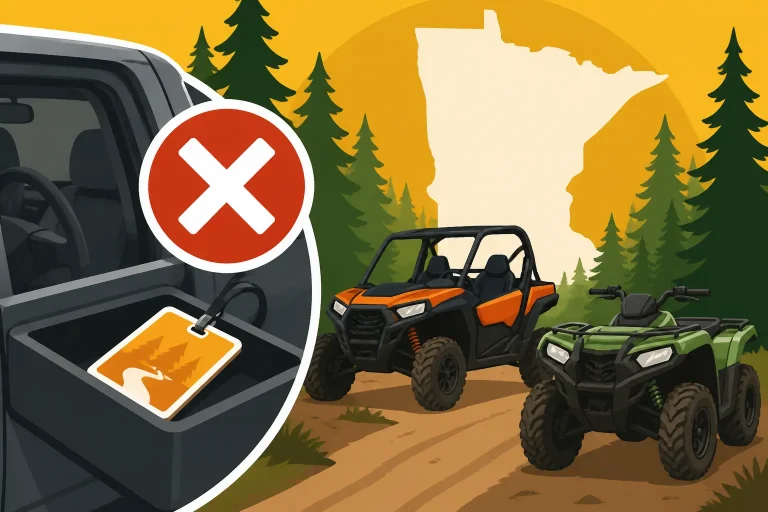
This is especially easy to mix up when a machine has a visible decal. The decal may show that a registration step has been completed, but it does not prove that the person operating the machine has completed safety training. Conversely, a rider may be properly certified while the machine has a registration issue. Think of these as separate documents and separate checks.
If you are buying, borrowing, or bringing a machine from another state, sort out its registration status as well as your own training. Minnesota’s machine rules can vary with how the ATV is used and where it is operated. The registration topic is covered in Registering an ATV in Minnesota, while a visitor bringing a machine should also review Minnesota Registration for an Out-of-State Machine.
A trail pass is another separate requirement
Some Minnesota trails require a trail pass, depending on the machine and its registration status, the rider’s situation, and the trail system. A safety certificate does not grant trail access by itself. Likewise, having a pass does not establish that the operator has completed required safety training.
It may help to picture a family arriving at a trailhead with two machines. Both machines may have the correct registration, and the family may have acquired any pass needed for that route. But if an operator is in the birthdate group required to be certified and has not completed the training, the pass does not solve that problem. Each requirement answers a different question: Is the machine properly documented? Does this ride require a pass? Is this operator qualified under the applicable training rule?
Visitors should check both the trail-pass requirement and the safety-certification rule before leaving home. A pass may be relevant to one trail network but not another, while certification follows the rider in covered riding situations. For details on pass requirements and visitors, see Minnesota’s Non-Resident ATV Trail Pass and Which Minnesota Trails Require a Pass.
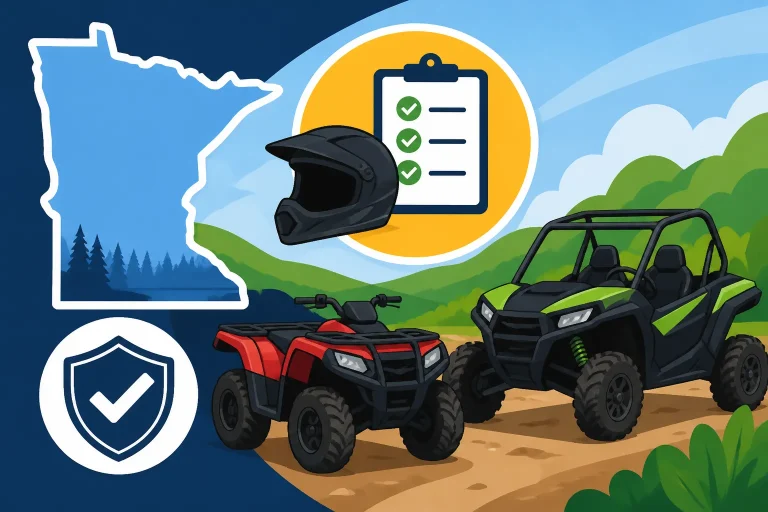
Use a pre-ride checklist to catch missing pieces
The simplest way to avoid a frustrating delay is to separate the checks instead of asking, “Are we legal?” as though there were one document that answers everything. Confirm the rider’s training status, the machine’s paperwork, the pass requirement for the planned route, and any age or local restrictions.
| Pre-ride question | What it relates to | What to check |
|---|---|---|
| Does this rider need safety certification? | Operator training | Birthdate, age, riding location, and accepted proof |
| Is this machine properly documented? | Machine registration | Registration status and use category |
| Does this route require a pass? | Trail access | Trail system, machine, and visitor status |
| Is the rider allowed to operate this machine here? | Age and operating rules | Rider age, machine type, supervision, and location |
| Can the rider show proof if asked? | Documentation | Certificate access and any other required records |
A checklist is especially useful when a group includes relatives who are visiting from out of state. One person may manage the trailer and machine paperwork while another assumes everyone has handled training. Ask each operator directly rather than relying on the group organizer’s documents.
Keep relevant proof accessible, but do not treat a phone screenshot as a substitute for confirming what is accepted. Save documents in a place that can be reached even if a phone battery dies or there is no signal. If a course provider issues a card or other proof, keep it with your riding records and know how to retrieve a replacement if it is lost.
Completing training and keeping proof
Choose a course and complete every required step
Riders who need certification should look for the Minnesota ATV safety training option that applies to their age and circumstances. Course formats and procedures can vary, so read the instructions carefully before beginning. A rider who stops after registering, watching lessons, or starting a quiz may not have completed the full process.
An online course can be convenient for someone who lives far from an in-person option or wants to work through lessons at home. It is still worth setting aside enough time to focus. A teen working through a course between other activities may click through material without absorbing the practical points about terrain, visibility, braking distance, passengers, and riding near other trail users.
For families, doing the course before a trip is less stressful than trying to complete it on the road. Check the completion requirements, save the confirmation, and make sure the rider knows where the proof is stored. For more detail on available training routes, read Minnesota Online Safety Training and Minnesota Hands-On Riding Clinics.
Treat training as practical preparation, not just a card
The value of safety training is not limited to satisfying a rule. It gives riders a structured chance to review hazards that can be easy to underestimate when a trail looks familiar. A blind bend, soft shoulder, standing water, a steep slope, or another machine coming the opposite direction can change a routine ride quickly.
Newer riders may be most concerned about basic controls, but experienced riders can benefit from revisiting habits too. For instance, a person who is comfortable on a dry gravel trail may be less prepared for mud, loose rock, or a washed-out section. Training can reinforce the importance of slowing down, leaving room, choosing a safe line, and not assuming that a group’s lead rider has cleared every hazard.
Parents can use training as a starting point for a conversation with a young operator. Ask the rider to explain what they would do if the group becomes separated, the machine stalls on a slope, or someone is injured away from the staging area. That kind of discussion helps turn a course credential into habits that matter on the trail.
Store proof where it will be available
After completing training, save the certificate or other accepted proof in more than one place. A paper copy can be useful if a phone is damaged, while a digital copy can be convenient during travel. Keep the original completion details or course account information somewhere secure so that a lost card does not become a last-minute problem.
For group rides, make sure each operator can access their own proof. It is not enough for the organizer to have a folder of documents if riders split up or someone takes a different machine. A quick check before loading the trailer can catch a missing credential while there is still time to address it.
If your certificate is misplaced, find out how the training provider handles replacement or retrieval before your next ride. Do not assume that a photo of an old card, a payment receipt, or a course login screen will count as acceptable proof. The answer can depend on the credential and the circumstances, so use the official process for confirming or replacing it.
Common misunderstandings that create problems
“I’m an experienced rider, so I do not need the course”
Experience and certification are not interchangeable. A rider who has spent decades on private land may have strong practical judgment, but the birthdate rule can still require formal training in covered public settings. The requirement is not a test of whether someone is already skilled; it establishes a recognized training step for certain operators.
This misconception often surfaces when a group plans a ride on short notice. One person says they have “been riding since they were a kid,” and the group assumes that settles the question. It does not. Check the cutoff date and location, and complete the required training before riding if it applies.
The reverse mistake happens too: someone assumes that taking the course means there are no other restrictions. Training does not override age limits, supervision rules, registration requirements, trail-pass rules, or local closures. Certification is one part of preparation, not a universal permission slip.
“The machine is registered, so the rider is covered”
Registration is tied to the ATV, not to every person who operates it. If a friend borrows your machine, that friend’s own training requirement still matters. If a family shares one machine, every operator should check their individual status instead of relying on the owner’s paperwork.
The same separation applies to trail passes. A rider may be certified but still need to confirm whether the machine and route require a pass. A registered machine may not resolve every visitor or trail-access question. The most reliable approach is to review the machine, operator, and route independently.
This distinction becomes particularly important when someone is riding a borrowed or rented machine. Before accepting the keys, ask who is responsible for the machine’s paperwork and what the operator needs to carry or access. A friendly handoff does not transfer another person’s certificate or make a route requirement disappear.
“The rule only matters on a long trail ride”
A short ride can still enter a covered public setting. A quick trip from a cabin to a public trail, a brief stretch along a right-of-way, or a ride across a public recreation area may raise the same basic certification question as a full-day outing. Distance alone is not a dependable way to decide whether a rule applies.
Routes also change. A family might begin on private land, cross a road, and continue onto a public trail. The rule for the first section may not answer the question for the next one. This is why planning based on the entire route is safer than focusing only on where the machine is parked or where the ride begins.
Before leaving, identify the land and trail types you expect to use. If the route is unclear, ask the relevant land manager or check the current rules for that specific area. A little advance planning can prevent a ride from ending early because an operator’s certification status was overlooked.
Planning for mixed-age and visiting groups
Check each operator separately
A group ride often includes people with different birthdates, ages, home states, and riding experience. Do not use one rider’s status as a shortcut for everyone else. Make a small list of operators and confirm the training requirement for each person based on their own circumstances.
For a family, that might mean an adult born before the cutoff, another adult born after it, and a teenager who has completed a course but must also follow youth rules. The family’s machine may be registered, but that still does not answer the certification question for each operator. Sorting out the details before the ride avoids uncomfortable conversations at the trailhead.
For a club or informal group, the ride organizer can remind participants to check their credentials without collecting unnecessary personal information. Sharing the requirement early is more useful than asking about it after everyone has arrived with trailers and gear. It also gives visitors time to confirm whether their out-of-state documentation is accepted.
Coordinate out-of-state credentials and trail access
A visiting rider may be dealing with several layers of unfamiliar rules: whether Minnesota recognizes their safety certificate, what registration status applies to their machine, and whether a trail pass is needed. These questions should be resolved separately. A recognized certificate does not automatically settle the registration or pass question.
Suppose a rider drives from Wisconsin with a registered ATV and a safety card earned at home. Before riding, that person should confirm whether the certificate satisfies Minnesota’s training requirement and whether the planned trail requires a pass for that machine and rider. Another visitor arriving from Iowa may need to check the same categories, even if their home-state process looks different.
Do not leave these questions until the group reaches a remote staging area. Save the relevant documents, check the route, and make sure every operator can explain their own status. If the ride includes trail systems managed by different agencies, verify the requirements for each part rather than assuming that one answer covers the whole itinerary.
Build a simple plan for families
Families can reduce confusion by keeping a shared folder for machine paperwork and a separate record for each operator’s training. Include birthdates or age milestones in the planning process, because a child’s rules may change as they grow. When a rider reaches a new age bracket, revisit the route and supervision arrangements rather than carrying forward last season’s assumptions.
Set expectations before the engines are started. Explain where the group will ride, which adults are responsible for supervision, what to do if the group separates, and where proof of training is stored. Children and newer riders should know that they can ask to stop if the terrain feels beyond their comfort level.
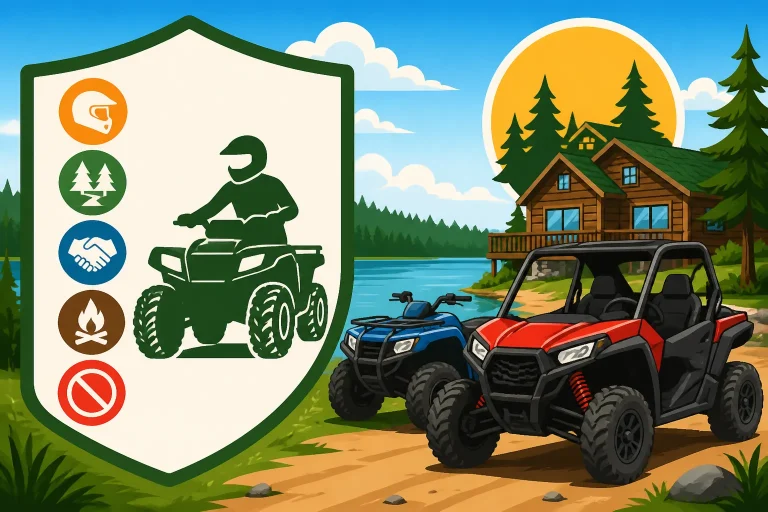
A basic gear check can make the same pre-ride routine more useful. Inspect helmets and eye protection, confirm that each rider has suitable clothing, and make sure the machine fits the operator. Some families use retailers such as Amazon to compare helmets or protective accessories, but a convenient purchase does not replace checking fit, condition, and applicable safety standards. A poorly fitting helmet can be uncomfortable enough that a young rider keeps trying to adjust it on the trail.
A practical checklist before riding
Before you leave home
Start with the cutoff date. If the operator was born after July 1, 1987, determine whether the planned riding location makes safety certification necessary. For a young rider, check age-specific requirements as well, including any supervision conditions. If the rider is visiting from another state, confirm that their credential is accepted rather than assuming it is.
Next, check the machine and the route independently. Confirm the ATV’s registration status, identify whether the route includes a trail system with a pass requirement, and look for local access restrictions or closures. If your plan includes public roads or rights-of-way, review the separate rules for those areas; training certification does not grant permission to ride where ATVs are otherwise restricted.
Finally, organize proof. Each operator should know how to access their own certificate, and the group should have the relevant machine and pass information available. Save a digital copy and consider a backup that does not depend on cell service. If anything is uncertain, resolve it before the trailer is loaded.
At the trailhead
Before unloading, confirm that the group is using the intended route and that no one has changed machines or operators without rechecking the requirements. A person who was only going to ride as a passenger may decide to take a turn operating; that change makes their individual training status relevant. The machine’s documentation remains a separate check.
Use the staging area to review basic safety expectations. Make sure riders know the planned route, regrouping points, and what to do if someone needs help. For a mixed-age group, identify which adult is supervising younger riders and make sure the arrangement follows the applicable rules for that age and setting.
If an officer or land manager asks for proof, stay calm and provide the document or access method you prepared. Avoid arguing from memory about whether the rule applies. If there is a genuine question about a certificate or route, ask how to verify it and make a note to resolve the issue before riding again.
After the ride
Keep your training record and machine paperwork organized after the trip. If you learned that a certificate needs to be retrieved, updated, or replaced, take care of it before the next outing. If a child has aged into a different category, update the family’s ride plan rather than assuming last year’s setup still applies.
It can also help to write down any route-specific restrictions you discovered. A trail network may have access rules that differ from another area, and a note can save time when you return. Keep those notes separate from the rider’s training proof so you do not mistake a trail map or pass receipt for a safety certificate.
If you regularly ride with visitors, share a simple preparation reminder well before the trip: check the July 1, 1987 cutoff, verify out-of-state certification, review age rules, and confirm pass and registration requirements. That small step helps everyone arrive ready to ride instead of trying to untangle paperwork at the trailhead.
Disclaimer
This article is for general informational purposes only and does not constitute professional advice. Laws, prices and regulations vary by location and change over time. Consult a qualified professional for guidance on your specific situation.