Speed on a Minnesota Road Right of Way
It's a familiar scenario for so many of us here in Minnesota: you're out on your ATV or side-by-side, maybe heading from your cabin down a township road's ditch to the lake, or perhaps riding a county road right-of-way to reach the next section of trail. You want to make good time, but also stay within the rules and avoid any trouble with law enforcement. Figuring out just how fast you can legally go on a Minnesota road right-of-way can feel like navigating a minefield of unspoken rules and vague guidelines. This guide is here to clear up that confusion, diving deep into the specific speed limits and crucial safety considerations for operating your off-highway vehicle (OHV) on public road rights-of-way throughout our beautiful state.
Understanding Minnesota's Road Right-of-Way Concept
Before we talk about speed, it's really important to get a handle on what Minnesota means by a "road right-of-way" when it comes to ATVs and UTVs. This isn't just a fancy legal term; it's the specific area where you are legally allowed to operate your machine adjacent to a public road, and understanding its boundaries is the first step to staying compliant and safe. Many riders assume "ditch riding" means anything goes, but there are clear parameters.
What "Right-of-Way" Really Means for ATV Riders
In Minnesota, the "road right-of-way" typically refers to the land adjacent to the traveled portion of a public road, which often includes the ditch, shoulder, and sometimes a strip of land beyond the ditch line. For ATV and UTV operators, the critical distinction is that you are generally permitted to ride within this right-of-way, but you are almost always prohibited from riding on the actual paved or graveled surface of the road itself. This distinction is paramount for safety and legality. Think of it as your designated corridor, running parallel to the traffic, but separate from it. This area is designated for ditch riding and is subject to specific regulations, including speed. For more general guidelines, check out [Minnesota's Ditch Riding Rules].
The width of this right-of-way can vary significantly depending on the type of road – a small township road might have a narrower right-of-way compared to a major state highway. It's often marked by utility poles, fence lines, or property markers, but sometimes it's less obvious. The general idea is to keep your machine well clear of moving vehicle traffic and to avoid encroaching on private property beyond the designated public access. Understanding this space is crucial because it influences not only where you can ride but also the applicable speed limits and other rules.
Why Roadsides Are Different from Trails
Riding a road right-of-way is fundamentally different from cruising down a designated ATV trail, and this difference dictates the rules you need to follow, especially regarding speed. Trails are designed for OHV use, often with varied terrain, banked turns, and less interaction with other types of traffic. They are built with the expectation of recreational off-road speeds and maneuvers. A trail might be wide open and allow for higher speeds where conditions permit, offering clear sight lines and minimal obstacles beyond what's expected in a natural environment.
Road rights-of-way, on the other hand, exist primarily to support vehicular traffic on the road, and your presence there as an OHV operator is secondary and highly regulated. The terrain might be rougher, narrower, and less predictable than a maintained trail. You're constantly sharing the environment with cars, trucks, driveways, mailboxes, and often pedestrians or cyclists. These factors necessitate a much more cautious approach to speed. The goal in the right-of-way isn't to blast through at top speed, but to safely and efficiently transit from one point to another, often to access trails or other legal riding areas. It's less about recreation and more about transit, which inherently means a lower speed threshold.
The Specific Speed Limits for ATVs in Minnesota Ditches
Alright, let's get down to brass tacks: what's the actual speed limit when you're riding your ATV or UTV in a Minnesota road right-of-way? This is where many riders get confused, and honestly, the rules aren't always as simple as a posted sign. Minnesota law provides some very specific guidelines, but also leaves room for common sense and adapting to conditions. You might be surprised to learn that it's often much slower than you'd expect.
General Speed Limits on Public Road Rights-of-Way
Minnesota statute is quite clear on the maximum speed for OHVs operating within a public road right-of-way. Generally, the speed limit for an ATV or UTV in a ditch or shoulder of a public road is 20 miles per hour (mph). Yes, you read that right – 20 mph. This applies to most township, county, and state highway rights-of-way where ATV use is permitted. This limit is significantly lower than typical road speeds and is designed to ensure safety given the inherent risks of riding alongside traffic, on often uneven terrain, and frequently in areas with limited sightlines. It's a hard limit, regardless of how fast the traffic is moving on the adjacent road. Exceeding this 20 mph limit can quickly land you a ticket, even if you feel like you're not going "that fast." Remember, this isn't about matching the flow of traffic; it's about operating safely within your designated corridor.
It's also important to note that this 20 mph limit is a maximum. It doesn't mean you should always go 20 mph. Many conditions will require you to go much slower. This speed limit is a critical piece of information for anyone who plans to ride on ditches, whether it's for getting to a trail or simply moving between properties. Ignoring it can have serious repercussions, both legal and safety-related.
Special Conditions That Reduce Your Allowed Speed
While 20 mph is the general maximum, Minnesota law also mandates that you must always operate your ATV or UTV at a speed that is "reasonable and prudent" under the conditions. This is where personal judgment comes into play, and it means that many situations will require you to go significantly slower than 20 mph. For instance, if you're riding after dark, your speed must be reduced to ensure you can stop safely within the range of your headlights. This is not just a suggestion; it's a legal requirement.
Consider conditions like heavy fog, rain, snow, or muddy terrain. All of these severely reduce visibility and traction, making even 10-15 mph potentially too fast. When riding near homes, farms, or businesses, you'll want to reduce your speed out of courtesy and safety, particularly if there are driveways or intersections where vehicles or pedestrians might suddenly appear. Likewise, if you encounter other riders, pedestrians, or even wildlife in the ditch, your speed must drop instantly to ensure you can react. Passing an intersection, bridge, or culvert also demands a reduction in speed. Even if your machine is equipped with top-tier suspension or high-performance tires from a brand like SuperATV, enabling it to handle rough terrain at speed, the law still requires you to be reasonable and prudent. The capability of your machine does not override the legal speed limit or the need for caution.
Navigating Different Road Types and Their Speed Rules
The type of road you're riding alongside can also subtly influence the specific rules and, by extension, how you might adjust your speed, even if the general 20 mph limit still applies. While the core law remains, practical considerations and local ordinances can add layers of complexity. Understanding these nuances helps you stay out of trouble and ride responsibly.
Township and County Road Ditches
Riding the ditches of township and county roads is perhaps the most common scenario for Minnesota ATV and UTV enthusiasts. These roads often form the backbone of local trail access, connecting private property to designated trail systems, or simply providing a means to get from one part of the community to another. For the most part, the 20 mph maximum speed limit applies uniformly here. However, it's crucial to be aware of local variations. Some counties or townships may have additional ordinances that further restrict speed or even prohibit ATV use on certain rights-of-way, so it's always wise to check with local authorities if you're unsure.
When riding these ditches, you'll encounter frequent driveways, mailboxes, and sometimes pedestrians or children. These are all reasons to reduce your speed well below the 20 mph maximum. You're also likely to see more farm equipment sharing these roads, which means you need to be extra vigilant and prepared to yield. The ditches themselves can be highly variable – from well-maintained, grassy shoulders to deep, uneven trenches filled with rocks or water. A high-quality skid plate or A-arm guards from SuperATV might protect your machine, but they won't protect you from a speeding ticket or an accident if you're going too fast for the conditions. Riders should always stay to the far right side of the right-of-way, traveling with the flow of adjacent traffic. For more specifics on these roads, see [Minnesota Rules on County Roads] and [Minnesota Rules on Township Roads].
State Highway Rights-of-Way
Operating an ATV or UTV on a state highway right-of-way is generally subject to the same 20 mph maximum speed limit as county and township roads. However, state highways typically involve much higher vehicle speeds on the paved surface, greater traffic volumes, and larger ditches. This means the potential for a dangerous interaction with road traffic is amplified. While it might feel like you could go faster in a wide state highway ditch, the legal limit still holds, and safety dictates an even more cautious approach.
The ditches alongside state highways can also be more complex, with features like drainage culverts, bridges, and highway exits/entrances that require extreme caution. You absolutely cannot ride on the paved shoulder or the main lanes of traffic. The intent here is purely transit, not recreation. If you need to cross a state highway, there are very specific rules to follow, including coming to a complete stop and yielding to all traffic. Always err on the side of caution and maintain a speed that allows you ample time to react to any situation, whether it's an approaching car or an unexpected change in the ditch terrain. Read [Minnesota Rules on State Highways] for further details.
Crossing the Road: Speed and Safety
Sometimes, you need to cross a road to get from one section of ditch to another, or to access a trail on the opposite side. While the main discussion is about riding in the right-of-way, the act of crossing a road is intrinsically linked to speed and safety. Minnesota law requires you to come to a complete stop before entering the roadway to cross it. You must also yield to all oncoming traffic. When you do cross, you should do so as directly and safely as possible, and at a 90-degree angle to the road. This means you should not be attempting to 'fly' across the road at speed, nor should you be veering diagonally.
Your speed during the actual crossing should be enough to efficiently get you across, but not so fast that it compromises your control or ability to react to sudden changes in traffic. Think of it as a controlled, deliberate maneuver. After stopping, look both ways, wait for a safe gap in traffic, and then proceed directly across. This is not the time for speed. The entire focus is on minimizing the time you are on the actual road surface while ensuring maximum visibility and control. Remember, even a brief moment on the paved surface must be done under strict conditions. Consult [Crossing a Minnesota Road on an ATV] for a deeper dive into safe crossing procedures.
Factors Influencing Safe and Legal Speed
While the 20 mph limit is a clear legal boundary, a truly responsible ATV or UTV rider understands that this is just one piece of the puzzle. There are numerous real-world factors that should prompt you to reduce your speed well below that maximum, ensuring both your safety and compliance with the spirit of the law, which demands "reasonable and prudent" operation.
Visibility, Weather, and Road Conditions
Perhaps the most obvious factors affecting safe speed are visibility, weather, and the condition of the ditch itself. Imagine a late autumn afternoon in northern Minnesota, with the sun low in the sky, creating glare, and the ditches still damp from a morning fog. Pockets of shadow hide unexpected ruts or standing water. In such conditions, even 15 mph could be too fast. Similarly, heavy rain, snowfall, or a thick blanket of fog drastically reduce your ability to see what's ahead, to gauge distances, and to react to obstacles. Your speed must be adjusted to allow you to stop within the distance you can clearly see. This is especially true at night, when you're limited by the range and intensity of your headlights. Having quality auxiliary lighting from a brand like SuperATV can certainly help illuminate the path, but it doesn't negate the need to ride at a speed appropriate for nighttime visibility.
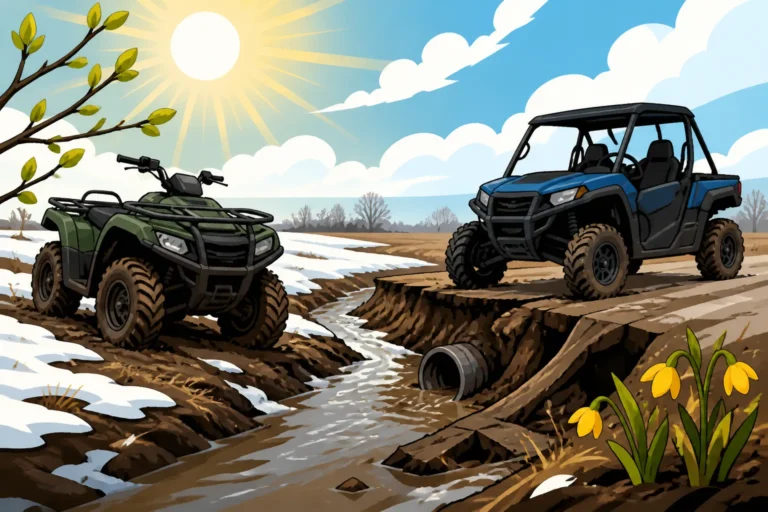
Beyond visibility, the physical condition of the right-of-way is crucial. Is it smooth and grassy? Or is it deeply rutted, rocky, or muddy? Riding at speed over rough, uneven terrain can quickly lead to a loss of control, an accident, or damage to your machine. Muddy or icy conditions severely reduce traction, making braking and steering far less effective. Always assess the surface you're on and choose a speed that allows you to maintain full control, even if you hit an unexpected bump or patch of slick material.
Proximity to Homes, Businesses, and Schools
Operating your ATV or UTV near populated areas, especially residential zones, businesses, or schools, demands a significant reduction in speed and an increase in vigilance. Even if the ditch is wide and open, the potential for sudden encounters with people, pets, or vehicles backing out of driveways skyrockets. Children playing near the right-of-way, people walking their dogs, or customers pulling into a business parking lot are all real possibilities.
In these areas, courtesy and safety should dictate your speed more than the legal maximum. Slowing down shows respect for residents and minimizes noise and dust, which are common complaints about OHV use. A slower speed gives you more time to react if a child chases a ball into the ditch, or if a car unexpectedly pulls out. Minnesota law often has specific noise regulations, and operating at lower speeds generally reduces your machine's noise profile, making you a better neighbor. It's not just about avoiding a ticket; it's about being a responsible member of the community and ensuring the long-term acceptance of OHV riding in public rights-of-way.
Machine Type and Your Riding Skill
The type of machine you're operating and your personal riding skill are also critical considerations. A smaller, lighter ATV might handle differently than a large, heavy side-by-side (UTV), especially in varying ditch conditions. A powerful sport quad will accelerate faster but might be more prone to losing traction on loose surfaces if operated too aggressively. While modern UTVs often have excellent suspension and stability, they are still subject to the same physical laws and traction limits as any other vehicle.
Your own experience and skill level play a huge role. An experienced rider might navigate a challenging section of ditch with ease at a certain speed, while a novice rider attempting the same speed could quickly get into trouble. If you're new to riding or unfamiliar with your machine, it's always best to err on the side of caution and keep your speed lower. Just because your machine can go faster doesn't mean it's safe or legal to do so in a road right-of-way. Always ride within your comfort zone and skill limits, especially when you're transitioning from a trail environment to the more constrained and unpredictable conditions of a ditch.
Enforcement and Penalties for Speeding on the Right-of-Way
Minnesota's rules for ATV and UTV operation on road rights-of-way aren't just suggestions; they are laws enforced by state and local authorities. Understanding how these rules are enforced and what the consequences are for violating them, especially regarding speed, is essential for every rider. Nobody wants to have their ride interrupted by flashing lights, or worse, face fines and other penalties.
What a Conservation Officer Looks For
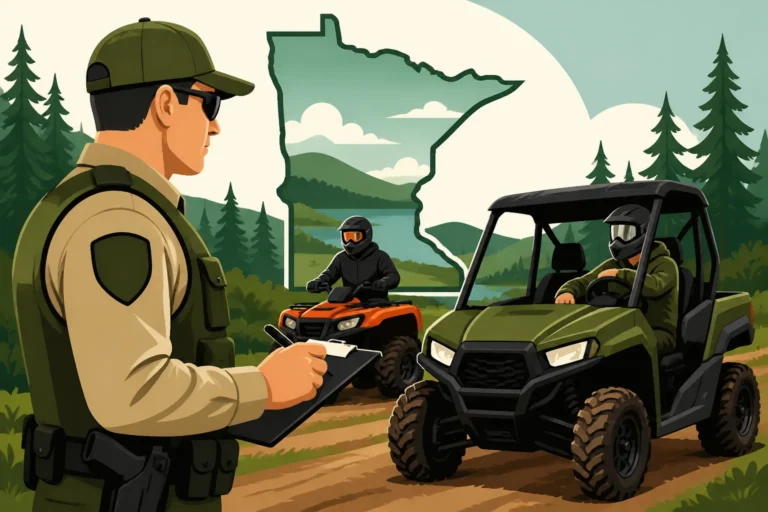
When you're riding an ATV or UTV on a Minnesota road right-of-way, you're most likely to encounter a Conservation Officer from the Minnesota Department of Natural Resources (DNR), but local law enforcement (county sheriffs, city police) also have jurisdiction. These officers are trained to identify violations, and speeding is definitely on their radar. They're looking for machines that are clearly exceeding the 20 mph maximum or operating at speeds "unreasonable and imprudent" for the conditions. This isn't always about radar guns; an experienced officer can often visually estimate speed quite accurately, especially if you're obviously moving much faster than the environment allows.
Beyond just speed, officers will also be observing how you're riding. Are you maintaining control? Are you staying well within the ditch and off the paved surface? Are you showing courtesy near homes or driveways? Are you wearing appropriate safety gear, like a helmet if required (e.g., for riders under 18)? They're also checking for proper registration, correct decal placement, and any required safety certificates. An infraction like speeding often opens the door to other checks. For example, if you're pulled over for excessive speed, the officer will almost certainly ask for proof of your registration and may inquire about your safety training. Keeping your paperwork with you, as advised in [Do You Carry Papers on a Minnesota Trail?], is always a good idea.
The Consequences of a Speeding Ticket
Getting a speeding ticket on your ATV or UTV in a Minnesota road right-of-way comes with a range of consequences. The most immediate is a fine, which can vary depending on the severity of the offense and any other concurrent violations. These fines can quickly add up, turning an enjoyable ride into an expensive mistake. Beyond the monetary cost, you might also face court appearances, which take time and can be a hassle.
Perhaps more significantly, repeated violations or particularly egregious speeding could lead to the suspension of your OHV operating privileges. This means you wouldn't be able to legally ride your ATV or UTV on any public lands or designated routes for a period of time, which can be a real blow for passionate riders. Furthermore, an ATV speeding ticket can sometimes affect your driving record, depending on how it's classified, potentially impacting your auto insurance rates. While these are typically considered non-moving violations for ATVs, it's always best to avoid them. The bottom line is that ignoring the speed limits on Minnesota road rights-of-way is not worth the risk, both for your wallet and your future riding opportunities. For a broader look at infractions, check [Minnesota Fines for Illegal Road Riding].
Beyond Speed: Other Important Right-of-Way Rules
While speed is a primary concern for safe and legal riding on Minnesota road rights-of-way, it's certainly not the only rule you need to know. There are several other critical regulations that go hand-in-hand with speed limits, all designed to ensure safety for OHV riders, vehicle traffic, and nearby property owners. Ignoring these can be just as problematic as going too fast.
Staying Off the Paved Surface
This cannot be stressed enough: you absolutely cannot ride your ATV or UTV on the paved or graveled surface of a public road in Minnesota, with very limited exceptions. The state law is extremely clear on this. The designated area for OHV operation is the right-of-way, which includes the ditch and shoulder, but explicitly excludes the traveled portion of the roadway. The only times you might legally be on the actual road surface are when crossing (at 90 degrees, after stopping and yielding) or when navigating a bridge or culvert where the ditch temporarily disappears, and then only for the shortest distance possible.
Riding on the road surface, even for a short stretch, is incredibly dangerous due to the speed and volume of vehicle traffic. It also immediately puts you in violation of state law, and law enforcement takes this very seriously. Many accidents involving ATVs and vehicles occur when an OHV operator unexpectedly enters the roadway. Always strive to remain in the ditch or designated off-road portion of the right-of-way. This also means you should be cautious about how close you get to the edge of the pavement, ensuring you don't inadvertently drift onto the road. For a comprehensive look at this, refer to [Can You Ride the Road Surface in Minnesota?].
Passenger and Helmet Rules Related to Road Riding
When you're riding in a road right-of-way, all other Minnesota OHV laws, including those pertaining to passengers and helmets, still apply. This is a common area of confusion, as some riders might think that because they're not on a designated trail, different rules apply. This is not the case.
Passengers: Most ATVs are designed for a single rider. If your ATV is not specifically designed by the manufacturer to carry a passenger, it is illegal to carry one, regardless of where you're riding. Side-by-sides (UTVs) are designed for multiple passengers and must use the manufacturer-installed seating and seatbelts. Doubling up on a single-rider ATV, even in a ditch, is a violation and incredibly unsafe.
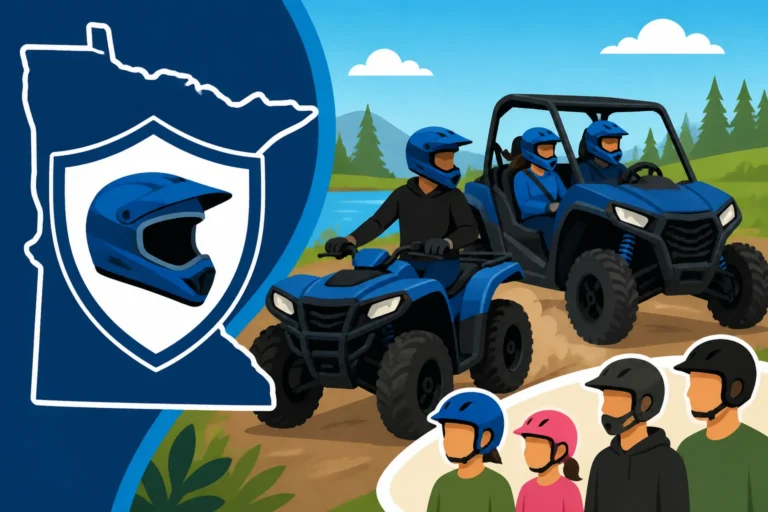
Helmets: Minnesota has specific helmet laws for ATV and UTV operators. All riders and passengers under the age of 18 are required to wear a DOT-approved helmet when operating or riding an OHV on public lands, which includes road rights-of-way. While adult riders (18 and older) are not legally mandated to wear a helmet, it is strongly recommended for safety. Wearing a helmet significantly reduces the risk of serious head injury in an accident, which can happen even at slow speeds in a ditch. Knowing these rules is crucial, and you can find more detail in [Minnesota Helmet Rules for Riders Under 18].
| Road Right-of-Way Rule Category | Key Requirement | Important Considerations |
|---|---|---|
| Speed Limit | 20 mph maximum in ditches/shoulders of public roads. | Always operate at a "reasonable and prudent" speed, reducing it for conditions like poor visibility, rough terrain, or proximity to homes. |
| Road Surface Use | Stay off paved/graveled road surface. | Only cross at 90-degree angle after full stop and yielding; use surface over bridges/culverts only when ditch is unavailable, for shortest distance. |
| Lane of Travel | Travel with the flow of traffic on the far right of the right-of-way. | Never travel against traffic. Maintain awareness of vehicles on the adjacent road. |
| Headlights/Taillights | Required when riding between sunset and sunrise or in conditions of reduced visibility. | Ensure lights are operational and visible. Some machines benefit from upgraded lighting from brands like SuperATV. |
| Spark Arrestor/Muffler | Must have a properly functioning spark arrestor and an effective muffler. | Ensures noise levels are reasonable and prevents wildfires. Aftermarket exhausts must still meet legal requirements. |
| Registration/Sticker | Machine must be currently registered and have the decal properly displayed. | Essential for all public land use, including ditches. Officer will check during a stop. |
| Safety Training | Required for riders born after July 1, 1987. | Carry proof of certification if applicable. See [Minnesota's ATV Safety Training Requirement]. |
| Alcohol/Drugs | No operation under the influence (same limits as cars). | DWI laws apply to OHVs. Open containers are prohibited. See [Minnesota Alcohol Limits for ATV Operators]. |
Navigating Minnesota's road rights-of-way on your ATV or UTV is a privilege that comes with significant responsibilities. By understanding and adhering to the specific speed limits, always prioritizing safety based on conditions, and following all other applicable laws, you can ensure your rides are enjoyable, legal, and safe for everyone sharing the environment.
Disclaimer
This article is for general informational purposes only and does not constitute professional advice. Laws, prices and regulations vary by location and change over time. Consult a qualified professional for guidance on your specific situation.