Buying Your First Side-by-Side in Minnesota
A first side-by-side can look like a simple choice between a few models, but the right one depends on where you’ll ride, what you’ll carry, and how you’ll pay for upkeep. Minnesota adds practical questions about trail width, seasonal conditions, registration, and storage. Start with the job you need the machine to do, then compare the full cost and paperwork—not just the sticker price.
Start with how and where you will use it
Before comparing brands or engine sizes, write down what the side-by-side needs to do. A machine used for family trail rides has different priorities from one that spends most of its time hauling supplies, working around a property, or plowing a driveway. A clear use case helps you avoid paying for capability you will rarely use—or buying a machine that does not fit your routine.
Think through the following questions:
- Will you ride mostly on managed trails, private land, roads where use is permitted, or a mix?
- How many people will usually ride together?
- Do you need a cargo bed for tools, firewood, hunting gear, or supplies?
- Will you tow a small trailer or use a winch?
- Do you plan to ride in mud, snow, woods, or open terrain?
- Where will the machine be stored, and how will you transport it?
- Do you want a simple machine for occasional use or one with features for longer, more frequent rides?
Match the machine to the trail
Trail access should be part of the decision before you buy, not a surprise after you bring the machine home. Width, turning room, and the type of trail all affect where a side-by-side can go. A full-size model may offer more room and comfort, but it can be too wide for some routes. A narrower machine may fit more places but provide less cabin space or cargo capacity.
Minnesota trails are not all designed for the same machines. Check the route rules, posted signs, and current trail information for the specific places you expect to ride. Do not assume that a route permitting ATVs automatically permits every side-by-side. Compare the machine’s actual width, as equipped, with the limits and access conditions that apply. A wider tire or accessory can change the machine’s overall dimensions. For route planning, see Minnesota Trails Rated for Full-Size Rigs and Minnesota ATV Classes and What They Mean.
Also consider how you will reach the trail. You may need to trailer the machine rather than ride it there. Riding on a road is not automatically allowed simply because a trail is nearby; local rules and road restrictions matter. Plan transportation and staging along with the route itself.
Match capacity to your usual group
Side-by-sides are built with different seating configurations. Choose one that carries the number of people you expect to have aboard, with seats and restraints designed for those occupants. A bench or rear seat does not make an otherwise single-row machine suitable for extra passengers. Do not base the purchase on the occasional plan to squeeze in one more person.
If children will ride, check the seating position, seat-belt fit, reach to controls, and the manufacturer’s passenger guidance. A cab, doors, nets, or other restraints can improve containment, but they do not replace correct seating or safe operation. Make sure everyone who will ride can sit securely and use the restraints properly.
If you often take longer rides, comfort is functional, not merely a luxury. Look at foot room, seat shape, visibility, access to controls, and whether occupants can get in and out without awkward climbing. A short test sit can reveal issues that a specification sheet will not.
Decide whether you need a utility bed
A cargo bed is useful for work and hauling, but its presence does not mean the machine is the best choice for trail riding. Compare bed size, payload guidance, and how the bed affects overall length. Think about what you will actually carry rather than choosing the largest capacity you can find. Overloading can affect handling and braking, and the machine’s manual is the authority for operating limits.
A utility-focused model may offer practical features such as a dump bed, towing capability, or a straightforward layout. A trail-focused model may prioritize passenger comfort, suspension travel, or a more compact footprint. Some machines do both reasonably well, but compromises remain. Be specific about your most common use, and treat occasional tasks as secondary unless they are important enough to shape the purchase.
| Main use | Features to prioritize | Trade-offs to check |
|---|---|---|
| Family trail riding | Appropriate seating, restraints, comfort, manageable width | Passenger capacity can increase size and hauling needs |
| Work around a property | Useful bed, towing guidance, easy access to controls | A larger utility machine may be less suited to narrow trails |
| Hunting or cabin use | Cargo capacity, quiet and controlled operation, storage | Added gear and accessories can increase weight and width |
| Snow work | Plow compatibility, traction setup, protection from weather | Plow equipment adds cost, storage needs, and maintenance |
| Mixed work and recreation | A balanced size, practical seating, adaptable equipment | A compromise machine may not excel at either specialty |
Choose the right size and equipment
A side-by-side that looks manageable on a showroom floor can feel very different in a narrow trail, a wooded yard, or a crowded trailer. Size includes more than body width. Overall length, wheelbase, turning radius, clearance, weight, and the height of the machine can all matter.
Do not compare machines by engine displacement alone. Engine size is only one part of performance. Consider how the machine responds at low speed, how easy it is to control, how it handles with passengers or cargo, and whether it suits the terrain where you will ride. A first-time owner may be better served by a controllable machine that fits the job than by the largest or most powerful option available.
Check dimensions in their ready-to-ride form
Ask for the machine’s width as equipped, including tires and any installed accessories that extend beyond the body. Confirm length and height, too, especially if you have a garage door, storage bay, trailer, or shed with tight clearances. Measure the actual spaces rather than relying on memory.
Consider width from the point of view of the narrowest trail or gate you expect to use. Also check the turning room available on your property and at the trailhead. A machine that technically fits may still be awkward to load, park, or turn around.
If you are comparing a machine with a roof, windshield, plow, tracks, or other add-ons, ask how those items affect dimensions and operating requirements. The configuration you buy may not have the same footprint as the base model shown in a brochure.
Think about the transmission and drive system
The best setup depends on your experience, terrain, and use. Ask the dealer to explain how the machine starts, shifts, and changes drive modes. Make sure you understand when four-wheel drive, differential settings, or other traction features should be used. The owner’s manual matters here: a feature that is useful in one situation may not be intended for every surface.
If possible, drive or sit in the exact configuration you are considering. Pay attention to throttle response, braking feel, visibility over the hood, and how easily you can reach switches while belted in. For a used machine, test how it behaves during a controlled low-speed drive, not just whether the engine starts.
Add accessories selectively
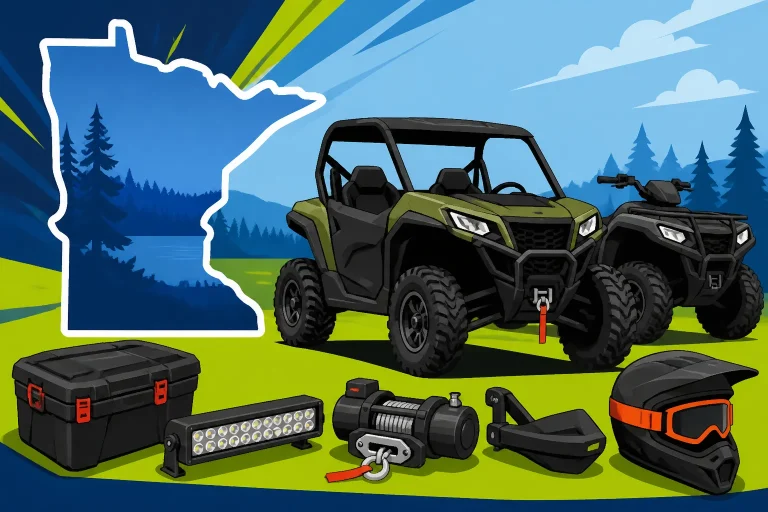
Accessories are easy to treat as part of the machine’s identity, but they add cost, weight, and maintenance. Start with what solves a real problem. A winch may help with recovery or work tasks, but it needs suitable mounting and safe operating practices. A plow can be useful for snow work, but it requires compatible equipment, storage, and attention to load and traction. A roof or windshield can improve comfort, but may alter clearance and airflow.
Make a list under three headings:
- Needed before the first ride: equipment required for safe transport, operation, or a planned task.
- Useful after you learn the machine: items that may help but can wait until you know what is missing.
- Cosmetic or speculative: upgrades that do not solve a current need.
This approach prevents the initial purchase from turning into a bundle of accessories chosen under showroom pressure. Compare installed accessories with the machine’s manuals and warranty terms, and ask whether installation affects service or coverage.
For basic hauling gear or maintenance items, a marketplace such as Amazon can be one place to compare options. Verify fit, load ratings, compatibility, and return terms rather than relying on a product photo or a generic description. Critical recovery equipment and safety gear deserve particular care.
Build a realistic ownership budget
The purchase price is only one part of the cost. A first-time buyer should budget for the machine, required taxes and paperwork, transportation, protective gear, storage, insurance, fuel, maintenance, and any equipment needed for the intended use. The exact amounts depend on the machine, location, use, and provider, so collect current figures before committing.
A useful total-cost worksheet separates one-time costs from recurring ones:
| Cost category | Questions to answer before buying |
|---|---|
| Machine | What is the complete out-the-door amount, including dealer charges and required taxes? |
| Registration and permits | What registration or trail-pass rules apply to this machine and planned use? |
| Transport | Do you need a trailer, hitch equipment, ramps, tie-downs, or delivery? |
| Safety gear | What helmets, eye protection, gloves, and other protective equipment are needed? |
| Insurance | What coverage is available, and what does the policy actually exclude? |
| Maintenance | What service is due, what can you do yourself, and what requires a shop? |
| Storage | Is your current space secure, dry, and large enough for the machine and accessories? |
| Fuel and riding | How far will you travel, and what are the likely trip and fuel needs? |
| Accessories | Which items are essential for your specific tasks, and which can wait? |
Ask for the complete purchase figure
When comparing dealer offers, request a written breakdown that makes the total clear. The advertised amount may not include every charge, tax, setup item, or accessory. Ask which items are mandatory, which are optional, and whether any work or equipment is already included. A clear quote makes it easier to compare two machines fairly.
Dealer charges and tax treatment can vary. Check the current rules and confirm the figures for the specific sale. The pages [Minnesota Sales Tax on a Dealer Purchase] and Minnesota Dealer Fees and Freight Charges explain the kinds of costs to ask about. Do not rely on a verbal estimate if the final paperwork is not yet prepared.
If you are buying privately, do not assume that avoiding a dealer means there are no tax, registration, or transfer obligations. Confirm how the transaction must be documented and what amount or records the relevant agency requires.
Budget for the equipment that makes the machine usable
A side-by-side may not be ready for your intended use when it leaves the seller. You might need a trailer, secure tie-downs, ramps, safety gear, a storage solution, or work equipment. Get quotes for these items before choosing a model. A machine that appears cheaper can become the more expensive choice if it requires a different trailer or extensive modifications.
Protective gear is part of the operating budget, not an optional afterthought. Make sure helmets fit the riders who will use them, and choose eye protection and clothing suited to the conditions. For family use, gear needs to fit each rider rather than being shared without regard to size.
Include maintenance and downtime
Maintenance depends on the model, how often you ride, and the conditions in which you operate. Mud, water, dust, heavy loads, and winter use can affect service needs. Review the maintenance schedule before buying and find out what regular service involves. Ask what tools or skills are required for routine checks and whether a local shop will service the machine.
For a used machine, include likely catch-up maintenance in your budget. A seller may describe it as ready to ride, but consumables and wear items still need inspection. A low purchase price is less attractive if the machine needs tires, brakes, a belt, battery work, or repairs immediately.
Storage has a cost even if you already have a garage. Make sure the space is secure, ventilated as appropriate, and protected from weather. If the machine will be stored outside or away from home, consider how you will secure it, maintain the battery, and keep records or accessories together.
For a broader seasonal cost checklist, see What a First Season Really Costs in Minnesota. Build your own estimate from the specific machine and riding plan rather than treating any general budget as a guaranteed figure.
Compare financing by total obligation
If you finance, compare the full amount you will pay over the agreement, not only the monthly payment. Ask about the down payment, interest, term, required insurance, fees, and consequences of paying late or paying off early. Read the documents before signing. A longer term may lower the monthly bill while increasing the total borrowing cost or leaving you owing money longer.
Set a payment limit based on your household budget after accounting for insurance, fuel, storage, maintenance, and riding expenses. If the deal only works when you ignore those costs, the machine may be too expensive for your situation.
A dealer’s financing offer is not the only possible route. Compare it with other lenders using the same assumptions and review the written terms. Financing a Machine at a Minnesota Dealer covers questions to bring to that conversation.
Decide between new and used
A new machine offers a known starting point and lets you choose a configuration, but it can involve a larger initial outlay and may still require accessories. A used machine can offer value, but its condition, service history, and paperwork matter more than the seller’s description. Neither option is automatically better.
| Factor | New machine | Used machine |
|---|---|---|
| Condition | Starts with little or no prior operating wear | Depends on use, maintenance, storage, and repairs |
| Choice | You may be able to select a specific trim or setup | Available machines may not match your preferred configuration |
| History | Purchase and service records begin with your ownership | Records may be incomplete or difficult to verify |
| Initial cost | Often higher before equipment and taxes | May be lower, but immediate repairs can erase the difference |
| Warranty | Ask what coverage applies and what conditions matter | Coverage may be limited, expired, or unavailable |
| Inspection | Confirm setup, included equipment, and delivery condition | Arrange a careful inspection and verify ownership records |
| Risk | Less uncertainty about prior use, not zero risk | Greater need to check wear, damage, and seller paperwork |
When a new machine makes sense
A new machine can be a good fit if you want a specific size or passenger setup, plan to keep it for a long time, and value knowing how it has been maintained from the start. It may also make sense if you need a configuration that is hard to find used.
Do not assume that new means no decisions remain. Inspect the machine at delivery, confirm that the accessories and documents match the sale, and understand the service schedule. Ask what the warranty covers, what it excludes, how claims are handled, and whether accessories or modifications affect coverage. Get the answers in writing.
When a used machine makes sense
A used machine may suit a buyer who can verify its history, arrange an inspection, and set aside money for maintenance. The purchase price alone does not tell you whether it is a good deal. Compare its hours, condition, service records, included equipment, and likely repairs with the cost of a comparable new machine.
Do not let a seller’s urgency replace basic checks. If there is no clear ownership paperwork, if the identification information is damaged or inconsistent, or if the seller refuses a reasonable inspection, pause the transaction. A machine that cannot be properly transferred can create a costly problem even if it runs well.
The broader checklist in Buying a Used Machine in Minnesota can help you organize the paperwork and seller questions. For a hands-on review, use Inspecting a Used Machine in Minnesota.
Inspect the machine and verify the seller
A good inspection is a process, not a quick glance at the bodywork. If you are not comfortable evaluating mechanical condition, arrange for a qualified technician to inspect the machine before you pay. The cost of an inspection is easier to weigh before a purchase than the cost of discovering serious problems afterward.
Start with identity and paperwork
Confirm that the machine’s identification number is present, readable, and consistent with the paperwork. Do not accept an explanation that a mismatch is unimportant without checking it through the appropriate official channel. Ask the seller to show proof of ownership and a clear path for transferring the machine.
Compare the seller’s name with the documents. If more than one person is listed as an owner, determine who must sign. If a lender has an interest in the machine, establish how that interest will be cleared before money changes hands. For a detailed ownership-paperwork checklist, see Proof of Ownership for a Minnesota ATV and Liens on a Minnesota ATV Record.
A bill of sale should identify the parties and machine, record the transaction terms, and document the date and signatures. Keep a copy. Do not hand over the full payment based on a promise that the paperwork will be mailed later unless you have confirmed a safe, legitimate process.
Look for condition issues
Check the machine in good light and ask permission before removing panels or checking fluid levels. Look for signs of impact, bent components, cracked plastics, damaged racks, loose fittings, corrosion, and mismatched parts. Fresh paint or cleaning is not proof of a problem, but it can make a careful inspection more important.
Look under the machine for damage, leaks, or evidence of heavy contact with rocks or obstacles. Inspect tires for uneven wear, cuts, cracking, and differences between them. Check wheels and suspension components for looseness or damage. Look at the axles and CV boots for tears, grease, or repairs that may need closer evaluation.
Inspect the seat, seat belts, doors or nets, cargo bed, and controls. Make sure the restraints latch and release properly. Check that switches and indicators work. Ask whether any warning lights are present and what caused them. Do not treat a warning that disappears after the machine warms up as automatically harmless.
Ask for a cold start and a controlled drive
If practical, ask that the machine be cold when you arrive. A warm engine can make some starting or running problems less obvious. Watch how it starts, idles, and responds to controls. Listen for unusual knocking, grinding, rattling, or belt noise. If the seller will not permit a reasonable start-up or test, treat that as a reason to slow down.
A test drive should be conducted safely, with the seller’s permission and in an appropriate location. Test low-speed control, steering, braking, drive modes, and shifting as allowed by the machine’s instructions. Avoid aggressive maneuvers. You are checking for predictable operation, not trying to prove what the machine can withstand.
Ask the seller what work has been done, what is currently wrong, and how the machine has been used. Specific answers supported by receipts are more useful than general assurances. Ask about water crossings, heavy plowing, modifications, collisions, storage, and periods when the machine was unused. Compare those answers with the machine’s condition.
Protect the transaction
Arrange payment only after ownership and transfer details are clear. Use a written bill of sale and make sure the person selling is authorized to do so. If the machine is being sold on someone else’s behalf, ask what documentation gives the seller that authority. Be cautious about pressure to pay a deposit before seeing the machine or paperwork.
If something does not add up, walk away or take time to verify it. A clean machine with a questionable ownership trail is not a safe purchase. Neither is a machine whose price assumes repairs you have not assessed.
Handle Minnesota registration, insurance, and access
Registration and access depend on the machine and how you plan to use it. Before you buy, explain your intended use to the relevant Minnesota agency or registration provider and confirm what applies. A machine used only on private property may be treated differently from one used on public trails or other public areas. Do not assume that the seller’s previous registration automatically fits your use.
Start by identifying the machine accurately: its type, ownership status, and intended riding locations. Then ask what documentation is required, whether a transfer or new registration is needed, and what rules apply to the places you plan to ride. Registering a Machine for Public Use in Minnesota and Minnesota Public Use Versus Private Use Registration cover the distinctions to check.
Confirm trail and route requirements
Registration, trail access, and local riding permission are related but separate questions. A registration record does not by itself guarantee access to every trail. Some routes have machine-type or width limits, seasonal closures, or other restrictions. Check current information for the specific route and machine before planning a trip.
Ask whether a trail pass or other permit is needed for your situation. Confirm the requirements for each rider and machine, rather than assuming one pass covers a group. If you are buying a machine from another state or taking a Minnesota machine across a state line, check the rules for both locations.
Arrange insurance before riding
Talk to an insurer before purchase, especially if the machine will be stored at a cabin, used for work, or driven by multiple household members. Explain where it will be used and what equipment is installed. Ask what liability and physical-damage coverage means in the policy, who is insured, and whether trailers, accessories, theft, or off-road use are covered.
Do not assume an auto policy or homeowners policy covers a side-by-side in every situation. Coverage varies by policy. Read the exclusions and ask for confirmation in writing if an answer affects your decision. Insuring an ATV in Minnesota provides a starting point for the coverage questions.
Keep the records organized
Keep the bill of sale, ownership documents, registration information, insurance details, manuals, service records, and receipts together. Store copies separately from the machine. If you are buying used, preserve the seller’s records and any inspection report. These documents can help with future service, claims, sale, or correction of a record.
Use a deliberate buying process
A disciplined process keeps the excitement of a first purchase from pushing practical checks aside. Make a shortlist, gather written information, and compare machines using the same criteria.
- Define the job. Write down your usual riders, terrain, cargo needs, storage limits, and transport plan.
- Set a complete budget. Include the machine, taxes, dealer charges, paperwork, insurance, gear, trailer needs, storage, and maintenance.
- Choose a size range. Confirm the width and overall dimensions needed for both trails and storage.
- Check local riding plans. Identify the specific routes and land where you expect to ride, then confirm access rules.
- Compare configurations. Look at passenger capacity, restraints, cargo needs, comfort, service access, and compatible equipment.
- Get written quotes. Ask dealers to separate required charges from optional accessories and services.
- Inspect any used candidate. Verify identity, ownership, condition, service history, and transfer requirements.
- Arrange insurance and transport. Make sure the machine can be covered, hauled, secured, and stored before taking delivery.
- Review the documents. Read the sale agreement, financing terms, warranty information, and any transfer paperwork before signing.
- Set aside a maintenance reserve. Keep room in the budget for service and repairs instead of spending the full amount on the purchase.
When comparing two machines, use a simple scorecard. Give each candidate a rating for fit with your usual ride, trail access, passenger comfort, cargo needs, transport, condition, and total cost. You can weight the factors that matter most. If trail access is essential, it should count more than a cosmetic feature. If work use is the priority, bed and towing needs may matter more than extra passenger space.
Avoid buying the machine that wins only because it has the most features. A feature is valuable when it addresses a real need and does not create a bigger problem, such as making the machine too wide for your preferred routes or too large for your storage space.
Questions to ask before signing
Ask the dealer or seller:
- What is included in the final written total?
- Which charges or accessories are optional?
- What documents will be provided at delivery?
- What must I do to register or transfer the machine for my intended use?
- What maintenance is due, and what service history is available?
- What coverage applies, and what conditions or exclusions should I understand?
- What are the machine’s dimensions as equipped?
- Is the machine suitable for the trails I plan to ride?
- What equipment is needed for safe transport and my intended work?
- If used, can I arrange an independent inspection before payment?
The answers should be specific enough to verify. If an answer depends on registration rules, trail status, insurance language, or a warranty, confirm it with the relevant source rather than treating a casual assurance as a guarantee.
Frequently Asked Questions
Is a side-by-side a good first off-road machine?
It can be, if its size, controls, and capability match your experience and intended use. Take time to learn the controls, read the manual, and practice in a suitable low-risk area before riding unfamiliar terrain. A larger or more powerful machine is not automatically easier or safer to operate.
Should I buy new or used?
Choose new if you value a known starting condition and a particular configuration. Consider used if you can verify ownership, inspect the machine, review its history, and budget for repairs. Compare the total cost and condition, not only the asking price.
Can I ride any Minnesota trail with a side-by-side?
No. Access can depend on the specific trail, machine type, width, seasonal conditions, and current restrictions. Check current route information before you travel, and do not assume that one trail’s rules apply to another.
What should I budget besides the purchase price?
Allow for taxes and dealer charges, registration or permits that apply, insurance, safety gear, transport, storage, fuel, maintenance, and accessories for your planned use. Get current figures for the specific machine and transaction.
What is the most important check when buying used?
There is no single check that replaces the others. Verify the machine’s identity and ownership paperwork, inspect its mechanical condition, review its history, and make sure it can be transferred for your intended use. If you are unsure about its condition, arrange a qualified inspection before paying.
Disclaimer
This article is for general informational purposes only and does not constitute professional advice. Laws, prices and regulations vary by location and change over time. Consult a qualified professional for guidance on your specific situation.