Ontario Riders Bringing a Machine to Minnesota
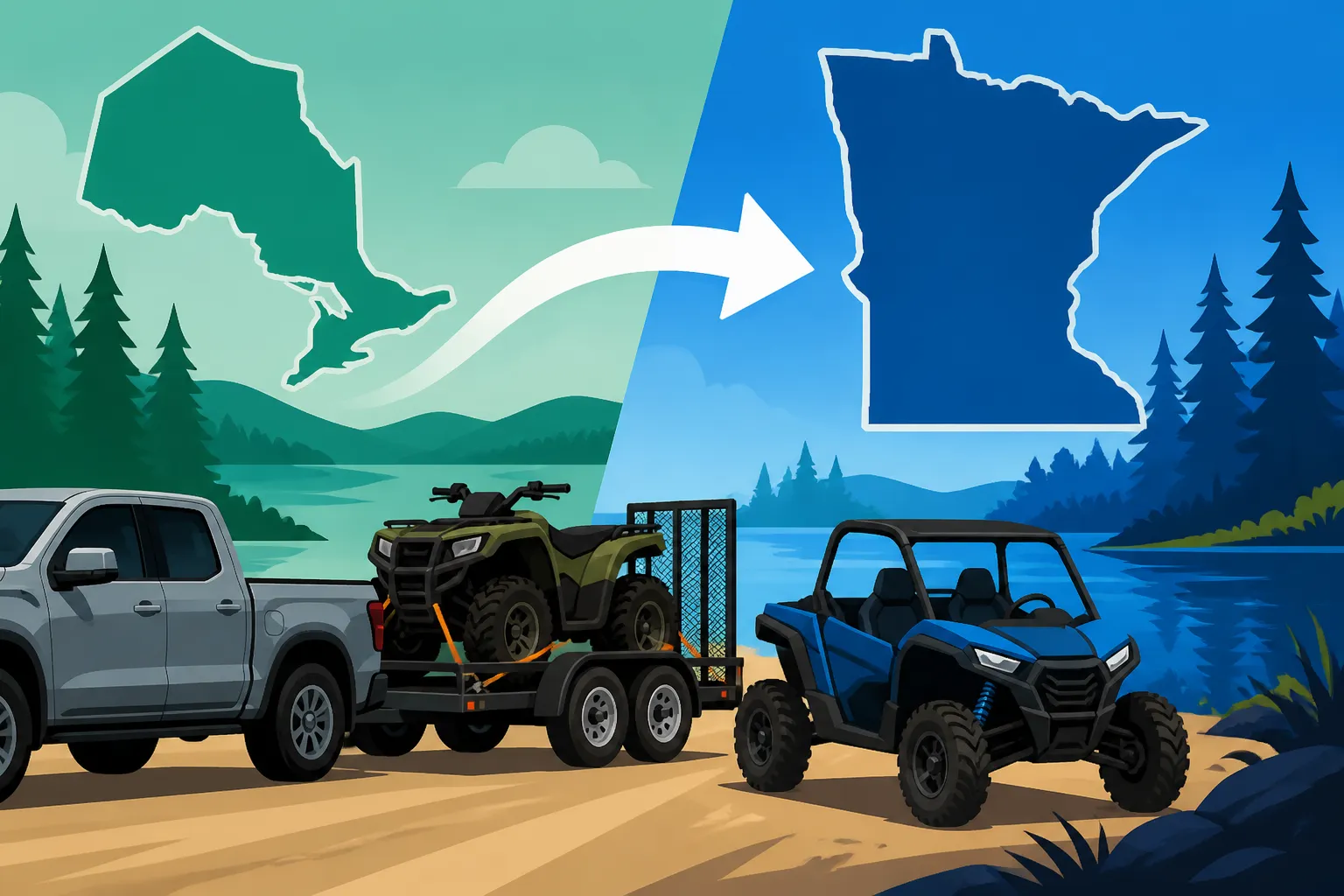
Bringing an ATV or UTV from Ontario to Minnesota takes more than loading it onto a trailer. You need to sort out the machine’s paperwork, Minnesota trail-pass requirements, insurance, and the rules for the places you plan to ride. The key is to check each item before crossing the border, because permission to bring a machine into Minnesota is not the same as permission to ride every trail.
Prepare the machine and paperwork before you travel
Start with the documents that identify the machine and show that you have permission to transport and use it. Keep them together in a waterproof folder, and carry copies separately in case the originals are lost.
For a machine you own, gather its Ontario registration or permit documents, proof of ownership, and any insurance information relevant to off-road use. If someone else owns it, get written permission to transport and ride it. If you are financing or leasing the machine, check whether the lender or leasing company places limits on taking it across the border.
The paperwork should match the machine. Check the vehicle identification number, or VIN, on the machine against the number on its documents. A mismatch can slow down a border inspection or create problems if an officer, insurer, or Minnesota registration agent asks you to identify it. If you are uncertain where to find the VIN, see Where the VIN Sits on a Quad.
It is also worth confirming that the machine is legally registered or permitted for use where you live. Minnesota’s trail pass does not replace Ontario paperwork, and Ontario documents do not automatically satisfy every Minnesota riding requirement. Each system serves a different purpose.
Before leaving, make a simple document checklist:
- Ontario registration or permit documents for the machine
- Proof of ownership, or written permission from the owner
- Insurance details and the insurer’s contact information
- Identification for the people travelling with the machine
- Any purchase, lease, or financing documents that clarify who may use it
- Emergency contact details and a copy of the VIN
Contact your insurer before the trip and ask specifically about riding in Minnesota. A policy that covers the machine at home may have different conditions for use outside Ontario, on public trails, or by another rider. Ask whether liability coverage applies, whether damage to the machine is covered, and whether there are restrictions on trail or road use. Get the answer in writing if possible. For background on the distinction between coverage types, see Minnesota Liability Coverage for Riders.
If you are borrowing a machine, do not assume the owner’s policy covers you. Ask both the owner and insurer who is insured, where the machine may be used, and what happens if it is damaged or involved in a collision. Is a Borrowed Machine Covered? can help you identify questions to ask.
Also plan for the crossing itself. Border authorities may ask about the machine, its ownership, or the purpose of your trip. Keep the paperwork accessible rather than buried under luggage or gear. If you are carrying equipment, fuel containers, or other restricted items, check the relevant border requirements before departure; do not assume rules for the machine also cover everything in the trailer.
Understand Minnesota’s trail-pass and registration requirements
The most important distinction for visiting riders is that machine registration and a Minnesota trail pass are not interchangeable. Registration identifies or authorizes a machine under a jurisdiction’s rules. A trail pass is a separate requirement tied to riding on certain Minnesota trails.
An Ontario registration document does not, by itself, establish that you can ride every Minnesota trail without another permit. Before you travel, check the current Minnesota Department of Natural Resources requirements for nonresident riders and for the type of machine you are bringing. Requirements can depend on the machine category, where it is registered, and where you intend to ride.
| What you have or plan to do | What it may cover | What to check before riding |
|---|---|---|
| Ontario registration or permit | The machine’s status under Ontario rules | Whether the paperwork is current and matches the VIN |
| Minnesota nonresident trail pass | Access requirements for certain Minnesota trails | Whether your machine and planned route require a pass |
| Proof of insurance | Coverage under your insurer’s policy | Whether coverage applies in Minnesota and on off-road trails |
| Permission to ride private land | Access granted by the landowner | Whether the permission covers the specific route and activity |
| A pass or permit from another jurisdiction | Requirements where it was issued | Whether Minnesota recognizes it; do not assume reciprocity |
Minnesota’s nonresident trail-pass rules are especially important if your trip includes public trails or trails maintained through Minnesota’s grant-in-aid system. Confirm whether your Ontario-registered machine needs a pass, how to obtain it, how it must be displayed or carried, and which trails require it. The rules and purchase options can change, so use current Minnesota DNR information rather than relying on an old pass, a friend’s advice, or a forum post.
For a broader explanation of the permit system, read Minnesota’s Non-Resident ATV Trail Pass. If you are unsure whether your route uses a trail that requires a pass, Which Minnesota Trails Require a Pass explains why checking the trail type matters. A pass for one machine should not be assumed to cover a second machine or every rider in your group; verify the requirements for each machine.
Do not confuse a trail pass with Minnesota registration. If you are considering registering the machine in Minnesota instead, first check whether that is necessary or appropriate for a temporary visit. The rules for a visitor may differ from those for a Minnesota resident, and a trail pass may still be relevant even when a machine has registration paperwork. Minnesota Registration for an Out-of-State Machine and Minnesota Rules for Visiting Riders are useful starting points for separating these questions.
Likewise, do not assume that a Canadian permit or a permit from another U.S. state is automatically accepted as a substitute for a Minnesota trail pass. Minnesota does not necessarily treat another jurisdiction’s authorization as equivalent. Check the current state rules directly; Reciprocity Minnesota Does Not Offer addresses why visitors should confirm rather than rely on assumed reciprocity.
If your plan includes only private property, ask the landowner what access is allowed and whether any public trail or road section is part of the route. A ride that begins on private land can still enter a public trail system, where different requirements apply. Permission from a landowner does not replace a required pass for a public trail.
Check the route, machine class, and rider rules
A Minnesota trail pass does not grant access to every trail. Trails can have restrictions based on machine type, width, season, conditions, or land-management rules. Before setting off, confirm that the trail is open and suitable for your ATV or UTV.
Machine size and configuration can matter. A wide UTV may not fit on a narrow trail, and a route open to one class of ATV may not be open to another. Check the posted signs and current trail information, and do not rely on a map alone if the trail has seasonal closures or changing conditions. The page Minnesota Trail Difficulty Ratings can help with route planning, while Checking Minnesota Trail Status Before You Drive is a useful reminder to verify conditions close to departure.
Road riding is a separate issue. A trail pass does not authorize riding on a public road. Minnesota restricts where off-highway vehicles may operate, and local rules can add limits. If you expect to connect trails through a town or use a roadside route, check the rules for that road and municipality in advance. Start with Riding an ATV on the Road in Minnesota and Minnesota Cities That Allow ATVs on Streets. Never assume that a route shown on an online map is an authorized ATV route.
Make sure the machine is equipped and operated in a way that meets the rules for the specific place you are riding. Requirements can include items such as lighting, a muffler, protective equipment, or restrictions on passengers. A closed cab does not automatically make a UTV exempt from operating rules, and a machine’s road-legal features do not necessarily permit it on a trail that excludes that class.
Rider age and training rules also deserve a check. Minnesota has requirements related to rider age, safety certification, supervision, and helmets. Those requirements may depend on the rider’s age, the type of area, and whether the person is operating or riding as a passenger. Do not assume that a certificate or training completed in Ontario is automatically accepted in Minnesota. Check the current Minnesota rules and confirm whether the certificate meets them. See Minnesota’s ATV Safety Training Requirement and Minnesota Age Rules for Young Riders for the main issues to verify.
For a group trip, check each person’s eligibility rather than treating the group as one unit. A younger rider may face different rules from an adult, and passengers may have separate requirements. If you are bringing children, plan a route and machine setup that match their abilities and the local rules. Minnesota Rules for a Child Passenger and Minnesota Helmet Requirements Under 18 can help you prepare.
Finally, consider conditions as well as legal access. Wet trails, spring thaw, wildfire restrictions, and seasonal closures can make a planned route unavailable or unsuitable. A machine that can physically travel a route is not necessarily allowed to do so. Stay on signed, open routes, and turn around when conditions or signs indicate a closure. Check Why Minnesota Trails Close for Thaw if your trip is planned during a wet or early-season period.
Use this pre-ride checklist to avoid preventable problems
A little preparation can prevent the most common difficulties: missing paperwork, a pass bought for the wrong machine, an unsuitable route, or insurance that does not apply. Work through this list before loading the trailer, then check the critical items again when you arrive.
- Confirm the machine’s paperwork. Make sure the Ontario documents are current, belong to the machine, and show the same VIN as the vehicle.
- Confirm ownership and permission. Carry proof that you own the machine or written permission from the owner to transport and ride it.
- Ask the insurer about Minnesota use. Confirm coverage for off-road operation, trail riding, and any additional drivers or passengers.
- Check the Minnesota trail-pass rules. Verify whether the machine needs a nonresident pass, how to obtain it, and how to carry or display it.
- Match the machine to the route. Check class, width, trail access, closures, and seasonal conditions.
- Check each rider’s requirements. Review rules for age, training, helmets, passengers, and supervision.
- Plan any road connections separately. Confirm that road or street riding is authorized before using it to connect trail sections.
- Keep documents available. Store registration, proof of insurance, pass information, and emergency contacts where you can reach them during the trip.
If you discover that a document is missing, do not assume a photo on your phone will be accepted in every situation. Ask the issuing authority or insurer what proof they will recognize, and resolve the issue before riding. If the VIN is hard to read or does not match the paperwork, pause the trip plan until you have clarified the discrepancy.
If your route crosses private property, confirm the boundaries and permission directly with the landowner. A trail may pass close to private land, and a GPS route can be imprecise. Do not ride around a gate, closure, or signed restriction simply because the detour appears convenient.
For visitors who plan to ride more than once, keep a record of what you checked: the date you confirmed the pass requirements, the routes you intend to use, and the insurer’s response. That makes it easier to prepare for another trip and reduces the chance of relying on information that has changed.
The safest assumption is simple: Ontario paperwork helps establish the machine’s status, but it does not automatically meet Minnesota’s trail-access rules. Confirm the pass, insurance, route, and rider requirements separately, and carry clear proof for each.
Disclaimer
This article is for general informational purposes only and does not constitute professional advice. Laws, prices and regulations vary by location and change over time. Consult a qualified professional for guidance on your specific situation.