Where Minnesota Trail Pass Money Goes
Minnesota trail-pass revenue helps keep public ATV routes open, signed, maintained, and available for riding. But the money does not simply go into a pot for the trail you used that day. Here’s how the funding system works, what it can support, and what a pass does—and does not—pay for.
How trail-pass revenue supports Minnesota riding
A Minnesota ATV trail pass is a user fee tied to access on certain public trails. Revenue from passes supports the broader trail system and its management, rather than being a direct payment to the particular trail or town where a rider buys or uses one.
That distinction matters. Trail networks cross different kinds of land and are maintained by different organizations. A single ride might use a route maintained by a local club, a public-land trail, and a connecting segment with separate rules. Funding and maintenance responsibilities can differ along the way.
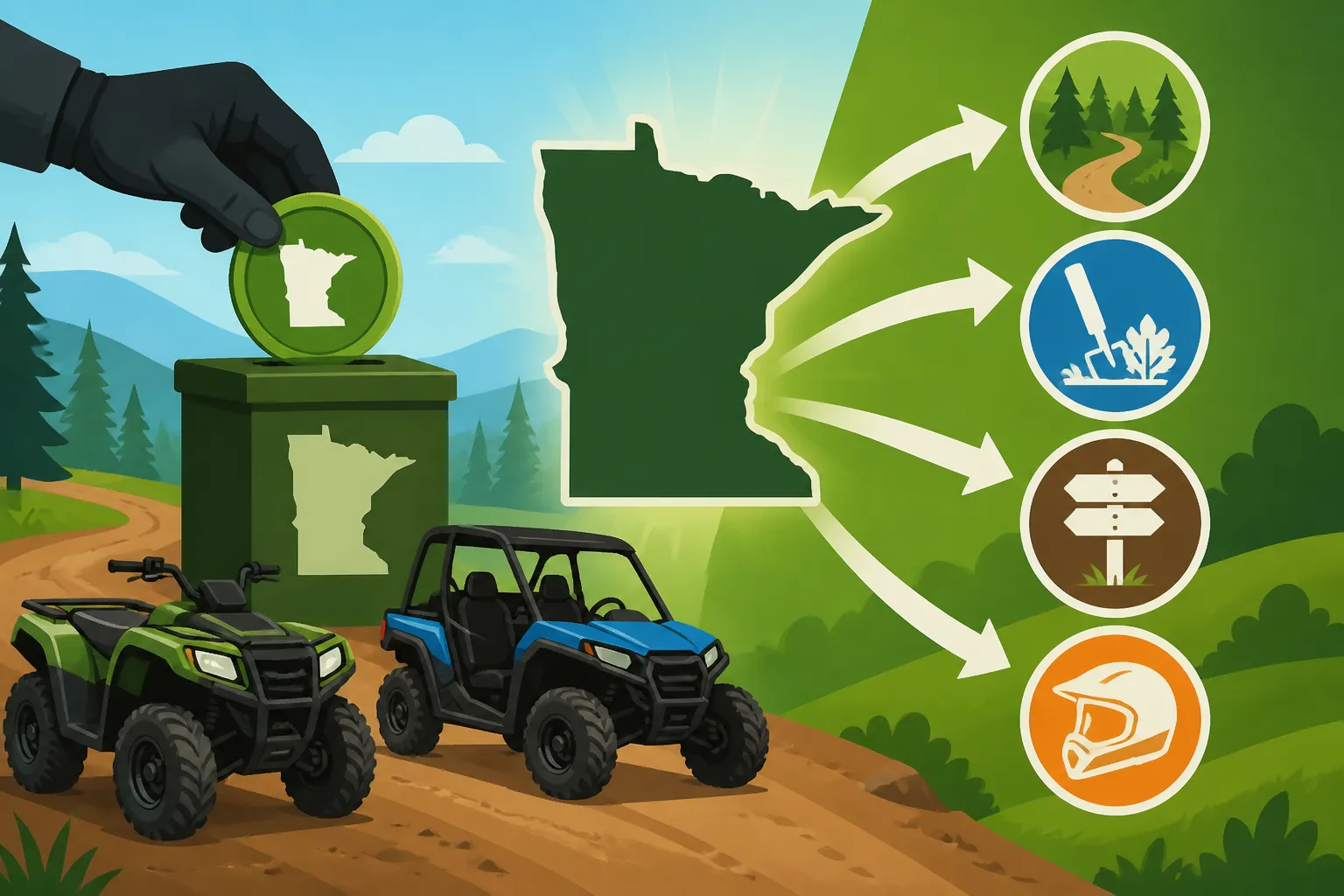
In general, pass revenue contributes to the public trail program that makes riding possible. Depending on program rules and approved projects, that support may help pay for work such as:
- Routine trail maintenance and repair
- Trail signs, maps, and route markers
- Drainage work, culverts, and erosion control
- Trail development or improvements
- Trail inspections and management
- Administrative work needed to operate the program
This does not mean every pass dollar is spent on visible work such as gravel, bridges, or signs. A trail program also needs planning, project review, coordination, and oversight. Nor should riders assume every item on a trail-maintenance project budget comes from trail passes alone. Public trails can involve multiple funding sources, land managers, local sponsors, and volunteer labor.
Minnesota’s grant-in-aid system is a major part of how many local trails are maintained. Local sponsors, which may include counties, townships, or other eligible organizations, work with the Minnesota Department of Natural Resources and local ATV clubs. Grants can help support eligible trail work, while clubs often provide hands-on maintenance and local knowledge. For more on these roles, see Grant-in-Aid Trails and Who Maintains Them and [Minnesota Grant-in-Aid Club Funding].
| What a rider pays for | What it generally supports | What it does not necessarily mean |
|---|---|---|
| A required trail pass | A statewide trail program and eligible trail work | The money is reserved for the exact trail ridden |
| ATV registration | Registration and related state program purposes | Registration automatically covers every trail-pass requirement |
| A permit or fee for a specific site or event | The site, event, or activity covered by that fee | It replaces other required passes or permissions |
| Voluntary club membership or donation | The club’s work and activities, according to its rules | It is the same as a required state pass |
The table is a practical distinction, not an accounting statement. Funding rules and eligible expenses can change, so check current information from the Minnesota DNR when you need to know how a particular fee is handled.
A pass is not the same as a registration
A common source of confusion is treating a pass and registration as interchangeable. They serve different purposes. A machine’s registration identifies it within the state’s registration system and may be required for its use. A trail pass is an additional access requirement for certain riders and trails.
Whether you need a pass can depend on the machine, its registration, the land or trail, and whether an exemption applies. Don’t assume that having a Minnesota registration means every trail-pass requirement is satisfied. The overview at Which Minnesota Trails Require a Pass can help you sort out where the pass applies, while Minnesota’s Non-Resident ATV Trail Pass covers the pass for visitors.
What trail funding can pay for
The most visible use of trail funding is physical work: clearing a route, fixing a washed-out section, improving drainage, or replacing signs. But keeping a trail open takes more than repairing damage after a storm. Funding may contribute to the work needed to plan, inspect, maintain, and manage a trail over time.
Maintenance and repair
Trail surfaces change with weather and use. Heavy rain can create ruts or washouts; repeated traffic can wear down a surface; fallen trees can block a route. Maintenance may involve clearing debris, grading or repairing a section, addressing drainage, and making other improvements allowed under the applicable program.
Not every trail receives the same work in the same season. A route’s condition, use, land-management rules, project approvals, and available funding all affect what can be done. A rough stretch is not proof that pass revenue is being ignored. It may be scheduled for a later project, outside the scope of an approved grant, or on land where another agency or owner has a different responsibility.
Signs and rider information
A safe, usable trail system needs signs that help riders follow the route and understand restrictions. Trail work can include installing or replacing markers, identifying intersections, and communicating closures or route changes.
Maps and notices also matter. A trail can be temporarily closed for maintenance, weather, land-management reasons, or other restrictions. Funding the trail system does not guarantee that every route will be open on every day. Before driving to a trailhead, check current conditions through official trail information. Checking Minnesota Trail Status Before You Drive explains what to verify before a trip.
Drainage and environmental protection
Water management is an important part of keeping trails usable and limiting damage. Depending on the site and approved work, projects may address drainage, erosion, or crossings. A well-planned repair can help keep riders on the designated route and reduce damage to nearby land.
Trail access is not permission to ride anywhere that looks passable. Riders are expected to stay on open, signed routes and follow closures. Leaving a trail can damage land and create safety problems, and it can put future access at risk. For more on the maintenance system and local work, see Reporting Trail Damage in Minnesota.
Planning and oversight
Some program costs are less visible than the work crews and machinery. Trail projects may require planning, coordination with land managers, review of proposed work, and oversight to ensure the project fits the applicable rules. Those steps are part of delivering trail improvements responsibly, especially where trails cross public land or connect different routes.
A useful way to think about the spending is that trail dollars support a managed system, not just a finished surface. Good management helps determine where work is needed, what kind of work is allowed, who will carry it out, and how riders are informed about the result.
How grant-in-aid trails fit into the picture
Many Minnesota ATV routes are part of a grant-in-aid trail network. In this system, local sponsors and clubs can take an active role in providing and maintaining trails, with program requirements and oversight involved. It brings local knowledge to the work: clubs and local partners may know where a route floods, where signs are missing, or which access point needs attention.
That local role does not mean a club receives every pass dollar collected in its area. Funding is generally handled through program processes and eligible projects, rather than being automatically assigned to the nearest club or trail segment. A project needs to fit the program’s rules and be approved through the appropriate process.
What a club may contribute
Clubs often help with practical work such as trail inspections, clearing, signage, reporting damage, and coordinating volunteer efforts. Their contribution can include time, equipment, local communication, and knowledge of riding conditions. Some trail work may be supported through grants, while other work may rely on volunteers or other resources.
This mix can make a trail system more responsive, but it also means that a trail’s condition may reflect more than the amount of fee revenue collected. A section might need a larger engineering project, a landowner agreement, or a repair that cannot be completed immediately. A volunteer crew may be able to clear brush quickly but not replace a damaged bridge.
Why one trail may look better maintained than another
Riders sometimes compare two routes and wonder why one appears to get more attention. There are several possible reasons:
- The trails may have different sponsors, land managers, or maintenance arrangements.
- One may have a more urgent safety issue or a project already approved.
- A route may have restrictions on the kind of work that can take place.
- Work may be scheduled around weather, seasonal access, or land-use needs.
- A local club may have different volunteer capacity or equipment.
- A trail may have recently experienced damage that is not yet repaired.
These differences do not tell you, by themselves, how much revenue a trail generated or where a specific pass dollar went. Pass revenue is not typically tracked by an individual rider’s route in a way that creates a direct payment back to that trail.
If you want to support the local network, consider joining an ATV club, participating in a work day, or reporting a problem through the proper channel. Those actions are not substitutes for required permits or passes, but they can help local groups keep trails usable. Joining a Minnesota ATV Club and Signing Up for a Club Work Day offer practical starting points.
What pass revenue does not cover for an individual rider
A pass contributes to a public trail program, but it is not an all-purpose riding permit. It does not give a rider blanket access to every trail, forest, road, private property, or special-use area. It also does not override a closure or replace other requirements that apply to a machine or rider.
It does not guarantee access everywhere
A trail pass only addresses the requirement it is meant to meet. Riders still need to check whether the route is open to their type of machine and whether other restrictions apply. A trail may have width limits, seasonal closures, land-use restrictions, or rules that differ by location.
A pass also does not grant permission to cross private land without authorization. Some routes may cross private property under a specific arrangement, but riders must stay on the marked route and follow posted conditions. See Passes and Minnesota Trails That Cross Private Land for the distinction between a pass and permission to use land.
It does not replace registration or safety requirements
Registration, trail passes, training or certification rules, and operating requirements are separate considerations. The exact requirements depend on the rider and machine. Check each one rather than assuming that one document covers the rest.
For example, a visitor riding a machine registered elsewhere may need to understand Minnesota’s visitor rules separately from the machine’s home-state registration. Minnesota Rules for Visiting Riders can help with that question, and Minnesota ATV Safety Training Requirements covers training requirements.
It does not act like insurance or roadside assistance
A trail pass does not provide personal liability coverage, accident coverage, a recovery service, or mechanical support. Riders remain responsible for their machine, gear, safe operation, and any insurance that may apply to their situation.
That is especially important on remote routes. A pass helps support a trail system; it does not ensure cell service, guarantee that a trail crew is nearby, or promise that a disabled machine will be recovered. Plan for the ride you are taking and carry appropriate equipment.
It does not guarantee that a route will stay open
Trail access depends on conditions and management decisions. A route may close because of wet ground, damage, fire risk, construction, landowner concerns, or other reasons. Pass revenue supports the system, but it cannot eliminate the need for closures when riding would cause damage or create a hazard.
A closure is not a sign that the trail program has failed. In some cases, keeping riders off a vulnerable section is what protects the route’s future. Check the trail status before departure and obey signs at the trailhead and on the route.
How to understand the funding as a rider
The practical takeaway is simple: buying a required trail pass helps support the shared system, but it is not a direct donation to one route and it does not purchase unrestricted access. If your question is whether a specific fee is required, start with the trail and machine rules. If your question is where the money goes, look at the broader program and the approved trail projects it supports.
Check the requirement before you pay
First identify the type of machine and the trail you plan to ride. Then check whether a pass is required for that use and whether an exemption applies. This avoids paying for the wrong credential or assuming a pass is needed where another rule applies.
Use the official Minnesota DNR information for current pass requirements, purchasing options, and program details. You can also review Minnesota Permit Rules on Grant-in-Aid Trails and When a Minnesota Rider Needs No Trail Pass if you are sorting out whether a particular ride is covered by an exception.
Keep required proof available
After buying a pass, follow the current instructions for how it must be carried or displayed. Don’t rely on a receipt alone unless the official instructions say it is acceptable. If you buy online, confirm what proof you need before riding and how the pass is associated with the machine.
For purchasing steps, see Buying a Trail Pass Through Minnesota eLicense. For questions about official program information, Minnesota DNR OHV Contacts is a useful place to start.
Report a problem with useful details
If you find a damaged sign, blocked route, or unsafe trail condition, report it with enough detail for someone to locate the problem. Include the trail name or route number if known, the nearest intersection or landmark, and a clear description. If it is safe, a photo can help explain the issue. Do not move a barrier or ride around a closure.
Reports help trail managers and local partners identify problems, but they do not guarantee immediate repairs. Urgent hazards, larger projects, and weather-related issues may need different responses and timelines.
Ask a specific funding question
If you want to understand a particular project, ask which organization maintains that section and whether it is part of a grant-in-aid route or another public trail arrangement. A question about one bridge or trail segment is easier to answer than a general question about where all pass revenue goes.
You can also ask what work was approved, which organization is the sponsor, and where current project information is available. Not every project will have a simple public breakdown by individual trail segment, but identifying the sponsor and program can clarify who is responsible for maintenance.
Frequently Asked Questions
Does my Minnesota ATV trail pass pay for the trail I ride?
Not directly in the sense of being assigned to that exact route. Pass revenue supports the broader trail program and eligible work. Local funding and maintenance responsibilities can vary by trail.
Do trail-pass fees pay for every repair on public ATV trails?
No. Pass revenue is one part of a larger system. Trail projects may involve grants, local sponsors, clubs, other funding, and volunteer work. Eligible expenses depend on program rules and project approval.
Does a trail pass include ATV registration?
No. A trail pass and registration are different requirements. Check both for your machine and the route you plan to ride.
Can I ride any Minnesota trail once I have a pass?
No. A pass does not override closures, trail restrictions, private-property permissions, or other rules. Confirm that the route is open and suitable for your machine before riding.
Where can I find current information about pass requirements and trail projects?
Check Minnesota DNR information for current requirements and program details. For local trail work, identify the trail sponsor or managing organization and ask about the specific route or project.
Disclaimer
This article is for general informational purposes only and does not constitute professional advice. Laws, prices and regulations vary by location and change over time. Consult a qualified professional for guidance on your specific situation.