Round River Drive in the Paul Bunyan Forest
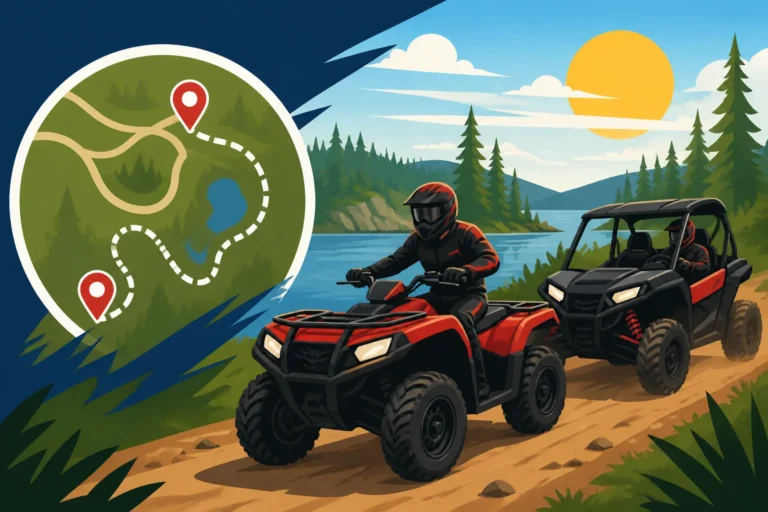
Round River Drive offers a way to explore the Paul Bunyan State Forest by ATV or UTV, but a good ride takes more than choosing a line on a map. Trail access, seasonal closures, changing conditions, and the mix of forest roads and riding routes can all affect your day. This guide covers how to plan, navigate, and ride responsibly in the area.
Getting Oriented Around Round River Drive
Understand the route before you unload
Round River Drive is associated with the Paul Bunyan State Forest riding network, but the name alone does not tell you exactly which roads or trails are open to your machine on the day you visit. Routes may connect with other forest roads and riding areas, and the legal status of a particular segment can depend on posted signs, land-management rules, and seasonal conditions. Treat a route name as a starting point for planning, not as permission to ride every nearby track.
Before leaving home, check an up-to-date map and look for the official route designation, access points, and any posted restrictions. Compare your planned route with [Riding the Paul Bunyan State Forest] and [Round River Drive Trail Mileage] so you can understand how the named route fits into the larger forest network. If a map, sign, or local notice seems to conflict with another source, follow the current signs on the ground and choose a clearly permitted route.
Forest roads and ATV trails are not interchangeable
A route that appears on a map may be a designated ATV trail, a forest road, a route shared with other users, or a road with restrictions. Those categories can come with different rules. Do not assume that every unpaved road in the forest is open to ATVs and UTVs, or that a route suitable for one class of off-highway vehicle is automatically suitable for another.
Pay attention to signs at intersections and trail entrances. A gate, closure notice, or vehicle-class restriction is a reason to stop and reassess—not an invitation to ride around the marker. Keep in mind that forest boundaries do not always match trail boundaries. A road can pass near private property, a wetland, or a closed section, so stay on the route you have confirmed is open. For help interpreting route symbols and designations, review [Reading a Minnesota OHV Trail Map].
Plan Your Route and Check Conditions
Confirm access, closures, and seasonal restrictions
Forest routes can change with weather, maintenance, and seasonal closures. Spring thaw is a particularly important time to check conditions because saturated ground can rut easily, and riding on vulnerable trails can damage the route or lead to a closure. A route that was open on your last visit may not be open now, so check again shortly before you travel rather than relying on an old screenshot or a friend’s memory.
Use official trail and land-management updates alongside current signs at the trailhead. If a route is closed, do not try to bypass the barrier by taking an unmarked connector or cutting across the woods. That can damage the land and create access problems for everyone who rides there. Before a spring trip, check [Minnesota Trail Closures in Spring Thaw] and [Checking Minnesota Trail Status Before You Drive]. When conditions are uncertain, choose another open route or postpone the ride.
Match the plan to your group and available time
A route can take longer than it looks on a map. Stops, traffic at intersections, a slow-moving group, rough patches, and navigation checks all add time. Plan a route that leaves room to turn back before dark, especially if riders are unfamiliar with the area or the group includes children. Agree on a turnaround point before you start, and make sure everyone knows what to do if the group gets separated.
Build a flexible plan instead of trying to cover as much ground as possible. A shorter ride with time for breaks and route checks is often more enjoyable than a long loop that leaves everyone watching the clock. Consider the size and capability of the least experienced rider’s machine, not only what the most powerful vehicle in the group can handle. [Minnesota Trail Difficulty Ratings] can help you think through how route conditions and rider experience affect the day.
Use digital maps as a backup, not your only plan
A GPS app can make it easier to follow a route, check your position, and spot nearby roads or trail connections. Some riders use onX Offroad to prepare a route and keep track of their location. Before relying on any app, review the map layers, download what you need for offline use, and confirm that the route is currently open. A visible line on a screen does not necessarily mean that the route is legal for your vehicle.
Cell service can be unreliable in forested areas, and a phone battery can drain quickly when the screen and GPS are running. Carry a charged phone, a backup power source, and a paper map or another navigation option. Save your starting point and agree on a meeting location in case riders get separated. Use onX Offroad as one part of your navigation plan, alongside official notices, trail signs, and common-sense route checks.
Choose a Machine and Prepare for the Ride
Think about machine size and route conditions
The right ATV or UTV for a Round River Drive trip depends on the route you intend to ride, current conditions, and the vehicle restrictions in place. A wider side-by-side may be comfortable for some forest roads but could be unsuitable for a narrow trail or a route with a width limit. An ATV can be easier to maneuver in tight spaces, but its capabilities still depend on its condition, tires, and the rider’s experience.
Check your machine’s width against any route restrictions before you leave. Do not assume that a vehicle can use a trail simply because it can physically fit through a gap. Also consider how your vehicle handles mud, loose surfaces, and uneven ground. Avoid forcing your way through soft or damaged sections; turning around is often the better choice for both the machine and the trail.
Do a practical pre-ride inspection
A quick inspection at home can prevent a frustrating stop far from the trailhead. Check tire pressure and tread, brakes, steering, lights, fluid levels, battery condition, and visible belts or hoses. Make sure the machine starts reliably and that essential controls work as expected. If you have recently serviced the vehicle or changed a part, take a short test ride before committing to a longer trip.
Carry the tools and basic repair items you know how to use. A compact tire repair kit, a suitable air source, and a few common hand tools can be helpful, but they are not a substitute for knowing how to use them. Secure loose gear, confirm that racks and storage boxes are latched, and check that passengers have properly fitted helmets and protective equipment. A small amount of preparation can prevent a minor problem from becoming a long walk back.
Pack for time away from the trailhead
Even a planned short ride can stretch out if you take a wrong turn, encounter a blocked route, or need to help another rider. Bring water, weather-appropriate layers, a basic first-aid kit, snacks, and a way to contact help. Keep essential items protected from rain and mud. If you are carrying a phone, store it where it is accessible but unlikely to be damaged in a fall.
Tell someone who is not riding with you where you plan to go and when you expect to return. Share the vehicle and trailer details if that will help them identify your trip. For a more complete packing checklist, use [What to Carry on a Remote Northwoods Ride]. It is also worth reviewing [Fuel Planning for a Minnesota Trail Day] before you set out, especially if you are unfamiliar with nearby fuel options or how much fuel your machine uses under trail conditions.
Ride Considerately on a Shared Forest Network
Stay on open routes and protect the trail
Riding off the marked route can harm vegetation, disturb wildlife, damage wet ground, and create new ruts that become more difficult to repair. Stay on the open route even when a shortcut looks tempting. Do not ride around a gate, follow tracks into an unmarked opening, or use a closed road simply because another vehicle has left tire marks there.
Give wet or fragile sections extra care. If you encounter deep mud, standing water, or an eroded patch, stop before entering and assess whether the route is passable without causing damage. Turning around may be the responsible choice. If you see a hazard, an obstruction, or damage that could affect other riders, note its location and report it through the appropriate local or land-management channel rather than trying to make an unauthorized repair.
Share the route with other users
Forest routes may be used by other ATV and UTV riders, hikers, cyclists, hunters, maintenance crews, or people traveling to nearby property. Reduce speed when visibility is limited, particularly around bends, hilltops, and intersections. Keep enough distance from the vehicle ahead to see the trail and stop safely if something changes. Raise dust only when conditions allow, and slow down near homes, parking areas, and other places where people may be present.
If you meet another group on a narrow route, make space carefully and avoid pushing into vegetation or soft ground to get past. Keep your group together without blocking intersections or trail entrances. A calm stop and a brief conversation can prevent confusion about who should pass first. For broader trail etiquette and volunteer maintenance context, see [Minnesota ATV Clubs and the Trails They Keep].
Set group expectations before the first turn
Groups often get separated because riders have different ideas about pace, stopping, and navigation. Before starting, decide who will lead and who will ride at the back. Agree that the lead rider will wait at intersections or at a predetermined regrouping point, and that nobody will take an unplanned turn without telling the group. If a rider falls behind, the last person should stop somewhere safe and let the group know.
Keep the pace comfortable for the least experienced rider. A machine’s speed or power does not make a trail safer, and pressure to keep up can lead to poor decisions. Make sure riders know the route plan, the turnaround point, and what to do if they become separated. If the group includes young riders, give them clear, age-appropriate instructions and keep them within the level of supervision required for their circumstances.
Arrange Parking, Breaks, and a Flexible Day
Check staging and parking before you tow
A well-planned ride can still start badly if the trailer does not fit at the chosen access point. Look for a suitable staging or parking area and confirm that it is open to the public and appropriate for your vehicle and trailer. Do not block gates, forest roads, driveways, or access needed by emergency and maintenance vehicles. Avoid parking on soft shoulders or vegetation when the designated area is full.
If you arrive and find no safe, permitted place to unload, do not improvise by leaving a trailer in a way that obstructs traffic or access. Have a second possible staging location in mind when practical, and make sure your group knows where to meet if vehicles arrive separately. For useful preparation, review [Minnesota Trailhead Parking and Staging]. Check the access point itself rather than assuming that a nearby road pull-off is an approved trailhead.
Build in breaks and a weather plan
A comfortable trip includes time to drink water, check navigation, and respond to changing weather. Northwoods conditions can shift, and rain can change the feel of a route quickly. If visibility drops, the trail becomes slippery, or a rider is cold or exhausted, pause and reconsider the plan. Continuing simply because the group has already traveled a certain distance is not a good reason to take on a risky return.
Agree on a practical stopping point before the ride and keep an eye on daylight. If the group has to turn back early, treat that as a successful decision rather than a failed outing. A route is only one part of the experience; getting everyone and every machine back safely matters more than finishing a loop.
Keep the day adaptable
A forest ride is not always predictable. A closed segment, an unexpected repair, or a change in weather may mean adjusting the route. Keep enough flexibility in your schedule and fuel plan to take a safer alternative or head back early. Avoid planning a day so tightly that a minor delay becomes a reason to rush.
A simple pre-ride comparison can help you decide whether your plan is ready:
| Planning item | Before you leave | At the access point |
|---|---|---|
| Route status | Check current notices and map information | Follow posted signs and closures |
| Machine access | Confirm the route suits your vehicle | Recheck restrictions at trail entrances |
| Navigation | Save maps and route details offline | Confirm your starting position |
| Group plan | Set a leader, tail rider, and turnaround point | Review the plan with everyone |
| Parking | Identify a suitable staging area | Park without blocking access |
| Backup plan | Choose an alternate route or return option | Change plans if conditions warrant |
Round River Drive can be part of a rewarding Paul Bunyan State Forest outing when the route is open and the group is prepared. Check current access information, ride only where permitted, and give yourself room to make a different choice if conditions change. A little planning helps keep the day enjoyable for your group and preserves the forest routes for future riders.
Disclaimer
This article is for general informational purposes only and does not constitute professional advice. Laws, prices and regulations vary by location and change over time. Consult a qualified professional for guidance on your specific situation.