Registering a Machine Kept at a Hunting Shack
You've got a fantastic hunting shack up north, a perfect retreat where the deer roam and the mosquitoes bite. And, of course, you've got your trusty ATV or UTV there, ready to haul gear, scout trails, or drag out that trophy buck. But here's the thing that often catches folks off guard: just because your machine lives at a cabin or shack that's not your primary residence, it doesn't necessarily get a free pass on Minnesota's registration rules. This guide is all about cutting through that confusion, making sure your hunting season is about the hunt, not a ticket for an unregistered machine.
Understanding Minnesota's Registration Mandate for OHVs
It's easy to assume that if your ATV or UTV is "up north" or "out at the shack," it's somehow in a different category. But the Minnesota DNR has pretty clear guidelines, and they mostly boil down to one critical question: where are you actually riding that machine?
Public vs. Private Use: Where Does Your Shack Fall?
This is the absolute cornerstone of Minnesota's ATV and UTV registration requirements. If your machine is ever going to touch public land – and that includes state trails, county roads, designated ditch riding areas, or even crossing a public road to get from one section of private land to another – it absolutely needs to be registered. Period.
Now, let's get realistic about hunting shacks. Very few hunting camps are so completely isolated that a machine never, ever sees a public access point. You might use it to ride a short stretch of gravel road to get to your deer stand, or maybe your private land connects directly to a public forest trail. Perhaps you run down the ditch alongside a county road to get to a different part of your property. All of these scenarios typically fall under "public use," making registration mandatory.
The only real exception is if your hunting shack and all your riding areas are entirely enclosed within private property, and you never leave those boundaries for any reason with the machine. No public roads, no public trails, no ditch riding. Just pure, unadulterated private land use. In that very specific and often rare case, you might be exempt. But honestly, for most hunting shack owners, some form of public access or crossing is almost inevitable, meaning registration is a must. The DNR doesn't care where the machine lives; they care where it rides.
The Importance of a Three-Year Registration Cycle
One thing that might offer a little relief amidst the paperwork is that Minnesota's ATV and UTV registrations aren't an annual headache. When you register your machine, you're paying for a three-year cycle. This means you don't have to scramble to renew it every single hunting season, which is great news if you're only making it up to the shack a few times a year. Once it's done, you're good for a while.
This three-year cycle makes it easier to keep track of, but it also means that if you forget, you're looking at a longer period of non-compliance. It's a system designed for convenience but still requires you to be proactive every few years. Knowing this upfront helps you plan when to tackle the process. You can learn more about [Minnesota's Three-Year ATV Registration] and get a deeper understanding of [Minnesota DNR ATV Registration Explained]. It's a system that makes sense once you understand the rhythm of it.
Navigating the Registration Process for Your Hunting Shack Machine
Alright, so you've decided your hunting shack machine likely needs to be registered. Great! Now, let's talk about the practical steps. It's not as daunting as it might seem, especially when you gather your ducks (or rather, your deer) in a row beforehand.
Essential Documents You'll Need to Gather
The key to a smooth registration process is having all your paperwork in order. Just like registering a car, you'll need to prove who you are and that you legitimately own the ATV or UTV.
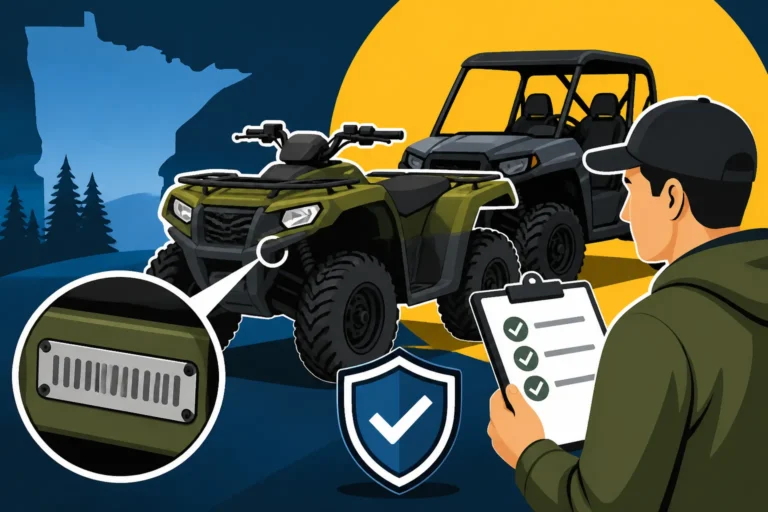
First and foremost, you'll need proof of ownership. This usually means a Certificate of Title, but if your machine is older and predates Minnesota's titling requirements, or if you bought it from a private seller who never got a title, a well-executed bill of sale is critical. Make sure that bill of sale clearly identifies the machine (year, make, model, and especially the Vehicle Identification Number or VIN), the seller's information, the buyer's information, the date of sale, and the purchase price. A generic slip of paper often won't cut it. For peace of mind, many people use services like LawDepot to generate a legally sound bill of sale, ensuring all the necessary details are captured. This is especially important for a machine that might be acquired during a casual transaction at a remote location. Without proper documentation, you might run into issues proving it's yours. We've got a whole article on [What a Minnesota Bill of Sale Should Carry] that dives into the specifics.
You'll also need personal identification, usually a valid driver's license or state ID. And, of course, be prepared to pay the registration fee. It's a one-time fee for that three-year period, so budget accordingly. For more on what documents are generally needed, check out [Proof of Ownership for a Minnesota ATV].
Where to Register Your ATV or UTV
So, where do you actually go to do this? You've got a couple of convenient options that work well, even if your machine is physically located hours away at the hunting shack.
Most folks opt to visit a Deputy Registrar's office. These are the same places where you renew your car tabs or get your driver's license. They're scattered throughout Minnesota, making it easy to find one close to your primary residence. You don't have to haul the ATV down to the office; you just need the paperwork. A list of locations can be found in [Deputy Registrars That Handle ATV Registration].
Another increasingly popular and convenient option, especially for those who live a good distance from their hunting shack, is online registration through the Minnesota eLicense system. This is a real game-changer. You can register your machine from the comfort of your home, upload necessary documents, and pay the fees. The registration card and stickers will then be mailed to your primary address. This means you don't have to coordinate a trip to a local office, which can be a huge time-saver. Learn more about [Registering Online Through Minnesota eLicense] for a step-by-step guide. It's a truly flexible way to keep everything legal without having to take extra time away from work or the cabin.
Special Considerations for Off-Season Use and Storage
Here's another scenario that hunting shack owners often ponder: "I only use my ATV for a few weeks during deer season, or maybe a couple of ice fishing trips. Do I still need to keep it registered year-round?" The answer, if you're using it on public land during those few weeks, is a resounding yes.
Minnesota's registration is not seasonal. It's a three-year permit for public land use. So, even if your machine spends 99% of its time parked in a shed at the shack, if that 1% involves riding down a public road ditch, crossing a state trail, or accessing public hunting land, it needs current registration for that entire three-year period.
Storage doesn't negate the need for registration if you intend to use it publicly at any point. Think of it like a boat. It's stored for months, but when you launch it, it needs current registration. The same principle applies here. So, while you might be winterizing it and putting it away for months, that doesn't excuse it from needing proper registration when you finally bring it back out for the next season. Taking the time to properly care for your machine during the off-season, including making sure its registration is current, is just part of responsible ownership. We also cover this in more detail in [Storing a Machine Through a Minnesota Winter], which talks about how to keep your machine in top shape regardless of use.
Common Scenarios and Lingering Questions for Hunting Shack Owners
The lines between private and public land can feel blurry, especially when you're out in the woods. Let's tackle some specific situations that commonly arise for owners of hunting shack ATVs and UTVs.
Using the Machine Only on Your Leased or Owned Hunting Land
This is where the rubber meets the road (or, more accurately, where the tire meets the dirt). If your hunting shack is situated on land you own or lease, and you can absolutely guarantee that your ATV or UTV never leaves that private property, then you are generally exempt from registration. "Never leaves" means not even for a quick jaunt down a county road ditch to check a remote part of your land, not crossing a public road to get to another private parcel, and certainly not riding a public trail that happens to border your property.
However, be realistic about this. Many properties, especially larger hunting tracts, might require a momentary crossing of a township road or dipping into a ditch to get to a different section of land. Even these brief forays onto public rights-of-way can trigger the registration requirement. What might feel like an extension of your private land to you is legally a public thoroughfare to a conservation officer.
If you ride on a friend's property, even with permission, the same rules apply to that friend's land: if their property involves public access, your machine needs to be registered. It's about the land you're riding on, not just the land the machine is stored on. For further clarity, you can review [Riding a Friend's Property in Minnesota] or [Do You Need Registration on Your Own Minnesota Land?] to understand the nuances of private land use.
Transporting the Machine To and From the Shack
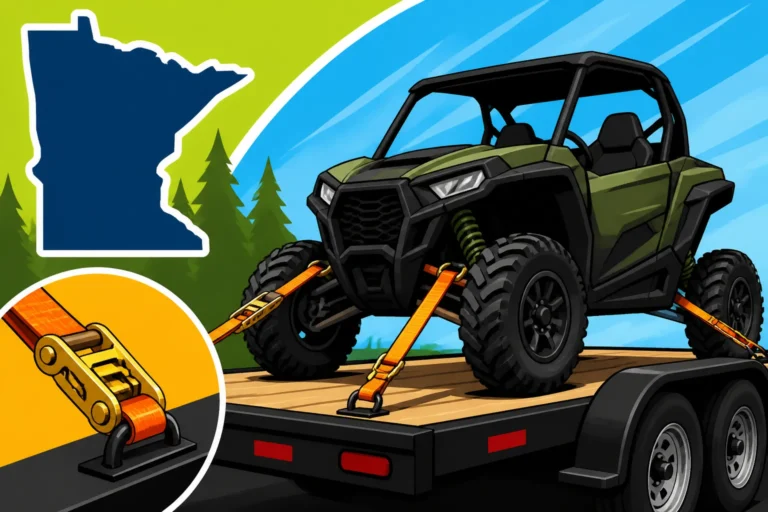
This is a really common point of confusion. Many owners think, "Well, I just trailer it up to the shack, so it doesn't need to be registered." While it's true that if your ATV or UTV is on a trailer, it doesn't need its own registration to be transported on the highway, the trailer itself needs to be registered (and that's a whole other topic – see [Trailer Registration for Hauling ATVs in Minnesota]).
However, the moment you unhitch that trailer and roll the ATV or UTV off onto public land (or land that accesses public land), it needs to be registered. The act of trailering it to the location doesn't exempt it from registration requirements once it's being operated in a way that requires registration. So, if you haul your machine up to the cabin for the weekend, and then plan to ride it down the road ditch to the nearest trail, it needs to be registered before you ever start that engine off the trailer.
The Role of a Bill of Sale and Ownership Records for Remote Machines
When your ATV or UTV is primarily kept at a hunting shack, it might not be as regularly seen or interacted with by you as a machine kept at your primary residence. This makes maintaining clear ownership records even more crucial. Imagine you're out in the woods, a conservation officer pulls you over, and asks for proof of ownership. If all you have is a crumpled receipt from three seasons ago, or worse, nothing at all, you're in for a potential headache.
A robust bill of sale, especially if you bought the machine privately, is your golden ticket. It demonstrates a clear chain of ownership, which is vital for both registration and any unforeseen circumstances like theft. Services like LawDepot can provide easy-to-use templates for a bill of sale that cover all the legal bases, ensuring you have a professional document. Even if you've owned the machine for years and it just sits at the shack, having that original paperwork readily available (perhaps stored securely at your main residence, with a copy at the shack) is smart.
This is also important if you ever decide to sell the machine. A clear, documented history makes the sale much smoother. Without it, you might find yourself in a bind. We discuss this more in [Buying a Used ATV in Minnesota: The Paperwork] and [Minnesota Records and a Machine's Ownership History]. Always keep those records organized, because when a machine is out of sight, it shouldn't be out of mind, especially regarding its legal standing.
Avoiding Pitfalls and Ensuring Compliance
Nobody wants to have their hunting trip ruined by an unexpected run-in with law enforcement over something preventable. A little preparation and understanding of the rules can save you a lot of grief.
Penalties for Unregistered Machines
Let's not sugarcoat it: riding an unregistered ATV or UTV on public land in Minnesota can lead to fines. Conservation officers, sheriff's deputies, and local police patrol ATV trails and ditch routes. They are well aware of the registration requirements and they do enforce them.
The penalties can vary, but generally, you're looking at a citation and a fine, which can easily be more than the three-year registration fee itself. On top of that, you might have to pay court costs, and in some cases, the machine could even be impounded until proof of registration is provided or the fine is paid. That's a surefire way to put a damper on your weekend. Avoiding these unpleasant scenarios is as simple as ensuring your machine is properly registered. You can find more detail on the potential consequences in [Penalties for an Unregistered ATV in Minnesota]. It's always better to be safe than sorry, especially when you're out enjoying the peace and quiet of the north woods.
Displaying Your Registration Sticker Correctly
Getting your machine registered is only half the battle; you also need to make sure that the registration stickers are correctly displayed. Minnesota law requires that the ATV or UTV registration decals be prominently displayed on the upper half of the side of the machine, or on the front and rear, depending on the machine type, in a way that makes them clearly visible. For ATVs, this typically means on the front and rear fenders. For UTVs, it's often on the front hood and the rear tailgate area.
They need to be securely affixed and kept clean so they can be easily read. If your sticker falls off due to weather, mud, or rough riding, you're still technically riding an "unregistered" machine in the eyes of the law, even if you have the physical card. So, make sure those stickers are on tight. If you need to know exactly where your stickers go, check out [Where a Minnesota ATV Registration Sticker Goes]. And if one ever does peel off, don't sweat it too much; there's a process for [Replacing a Minnesota ATV Decal That Fell Off].
Renewing Your Registration from Afar
When that three-year registration period is nearing its end, you'll receive a renewal notice, usually sent to your primary mailing address. But since your machine is often kept at the hunting shack, it's easy for this to slip through the cracks, especially if you're not checking mail regularly or if you only visit the shack intermittently.
The good news is that renewing is just as easy as the initial registration. You can usually do it online through the Minnesota eLicense system. This is incredibly convenient for hunting shack owners, as you don't have to be physically present with the machine or even in the same town as a Deputy Registrar. Just log in, confirm your information, pay the fee, and your new stickers will be mailed to you. It's a great way to ensure continuous compliance without any logistical headaches.
Keeping an eye on the expiration date is key. Make a note in your calendar, set a reminder on your phone, or create a recurring reminder on your computer. Don't rely solely on the mail, especially for a machine that's tucked away at the cabin. Being proactive here saves you from those potential fines and ensures you're always ready to hit the trail legally. We have detailed guides on [Renewing a Minnesota Registration Online] and [When a Minnesota ATV Registration Expires] to help you stay on top of things.
| Scenario | Registration Required? | Key Considerations |
|---|---|---|
| Riding on Public Trails/Road Ditches | Yes | Most common use case for hunting shacks, always requires registration. |
| Crossing a Public Road Briefly | Yes | Even a quick traverse to access another private parcel counts as public use. |
| Exclusively on Your Own Private Land | No | Only if absolutely no part of the ride touches public land or right-of-way. Verify property boundaries carefully. |
| Riding on Leased Hunting Land | Depends | If the leased land is accessed via public routes or connects to public trails, then yes. If fully enclosed private, then no. |
| Transported by Trailer | No (while on trailer) | Yes (when operated off trailer on public land). Trailer itself needs separate registration. |
| Stored Most of the Year | Yes | If used on public land at all during its three-year cycle, registration is required, regardless of storage time. |
This article is for general informational purposes only and does not constitute professional advice. Laws, prices and regulations vary by location and change over time. Consult a qualified professional for guidance on your specific situation.