Minnesota Registration Deadline for New Residents
Moving to a new state is a whirlwind of changes, from finding your way around new grocery stores to figuring out new schools and navigating an entirely different set of rules for your vehicles. It can be incredibly frustrating to discover that the beloved ATV or UTV you’ve always ridden, perfectly legal in your old state, now has a whole new set of hoops to jump through in Minnesota. This guide is here to cut through the confusion and help new residents understand the crucial deadline and process for registering their off-highway vehicles in the Land of 10,000 Lakes.
Understanding Minnesota's Grace Period for New Residents
When you bring your life, and your powersports machines, to Minnesota, you don't instantly have to run out and get new plates. The state understands that moving is a process, and they offer a bit of breathing room. However, this grace period isn't indefinite, and it comes with important caveats you'll want to understand to avoid any unexpected headaches down the road.
The 30-Day Window: What it Means for Your Machine
Minnesota offers new residents a 30-day grace period to get their off-highway vehicles registered. This means that from the moment you establish residency in Minnesota, or from the date you bring your ATV or UTV into the state with the intent to establish residency here, you have about a month to initiate the registration process. This isn't just a friendly suggestion; it's a legal expectation. During this window, you're generally allowed to operate your machine, provided it was legally registered and permitted in your previous state and you carry that documentation with you. However, it’s crucial to understand that even within this 30-day window, you're still subject to all other Minnesota operating laws, including safety training requirements for certain age groups and proper riding areas.
Establishing residency itself can sometimes feel a bit ambiguous, but typically it aligns with actions like getting a Minnesota driver's license, registering to vote, accepting employment, or enrolling children in school. The state isn't looking to trip you up, but rather ensure that folks who are truly making Minnesota their home integrate their vehicle registrations as well. Don't think of the 30 days as a free pass to ride anywhere; think of it as time allotted to gather your paperwork and complete the necessary steps without immediate penalty. Even if you're just storing your machine on your own land and not planning to ride public trails right away, you'll still need to consider this timeframe if you intend to become a permanent Minnesota resident.
Why the Deadline Matters: Avoiding Penalties and Confusion
Missing that 30-day deadline can turn a relatively simple administrative task into a much more complicated and costly problem. Once those 30 days are up, operating an unregistered out-of-state ATV or UTV on any public land or trail in Minnesota can lead to penalties. We're talking about potential fines that could put a serious dent in your wallet, and in some more severe cases, your machine could even be impounded. Imagine being pulled over by a conservation officer out on a beautiful trail ride, only to have your machine loaded onto a tow truck because you missed a deadline you didn't even realize existed. It’s a frustrating scenario many new residents have faced simply because they weren't aware of the specific rules.
Beyond just the risk of fines and impoundment, having an unregistered machine can create a bureaucratic nightmare down the line if you ever need to prove ownership for insurance claims, sales, or in the unfortunate event of theft. Proper registration links you directly to your machine in Minnesota's records, making all those future transactions smoother. Even if your machine falls under specific categories like those used for [Minnesota Rules for Farm and Utility Machines], the general rule for new residents applies if you plan any public use. Taking care of the registration within the allotted time demonstrates your intent to comply with state laws and keeps you in good standing with the Department of Natural Resources (DNR).
Step-by-Step: Registering Your Out-of-State ATV or UTV in Minnesota
The process of registering your off-highway vehicle as a new Minnesota resident might seem daunting at first glance, but by breaking it down into manageable steps, you'll find it's quite straightforward. The key is to be prepared with the right documents and to know where to go.
Gathering Your Essential Documents
Before you head out, you'll want to make sure you have all your ducks in a row. The absolute cornerstone of registering any vehicle, especially one from out of state, is solid proof of ownership. This typically means the certificate of title from your previous state if that state issued titles for ATVs/UTVs. If your former state didn't title these types of machines, or if you purchased it from a private party in a state that doesn't issue titles, then a clear bill of sale and your most recent registration from the previous state will be critical. The bill of sale should clearly list the buyer, seller, date of sale, purchase price, and the full Vehicle Identification Number (VIN) of the machine. If you're looking for a reliable template, resources like LawDepot often provide customizable bill of sale forms that can help ensure you don't miss any crucial details.
In addition to proving you own the machine, you'll also need to prove your identity and your new Minnesota residency. A valid driver's license or state ID card showing your Minnesota address is usually sufficient. Be prepared to show two forms of proof of residency if your driver's license is still from your old state, such as a utility bill, bank statement, or rental agreement with your new Minnesota address. Having all these documents organized and readily accessible will make your visit to the registration office much smoother. You can learn more about specific requirements by looking into [Proof of Ownership for a Minnesota ATV] and [What a Minnesota Bill of Sale Should Carry] to ensure you're fully prepared.
The Registration Process at a Deputy Registrar
Once you've got your documents in hand, your next stop will be a deputy registrar's office. These are the local offices, often associated with motor vehicle services, where you can handle various registration tasks, including those for off-highway vehicles. You can find a list of these offices by searching for [Deputy Registrars That Handle ATV Registration] online or by checking the Minnesota DNR website. When you arrive, you'll typically fill out a registration application form specific to off-highway vehicles. This form will ask for details about your machine, its VIN, and your personal information.
During this process, the deputy registrar will verify your ownership documents and confirm your identity and residency. They may also conduct a VIN inspection to ensure the number on your paperwork matches the number physically stamped on your machine. This is a crucial step to prevent fraud and ensure accurate records. You will then be required to pay the applicable registration fees, which cover a three-year registration period in Minnesota. Additionally, since you're bringing a machine into Minnesota from another state, you will likely be subject to Minnesota's use tax, which is essentially the state sales tax applied to items purchased out-of-state and brought into Minnesota for use here. This is an important detail that often catches new residents by surprise. For more on this, you might want to review [Minnesota Sales Tax on an ATV Purchase] and [Minnesota Use Tax After an Out-of-State Buy].
What to Expect After Registration
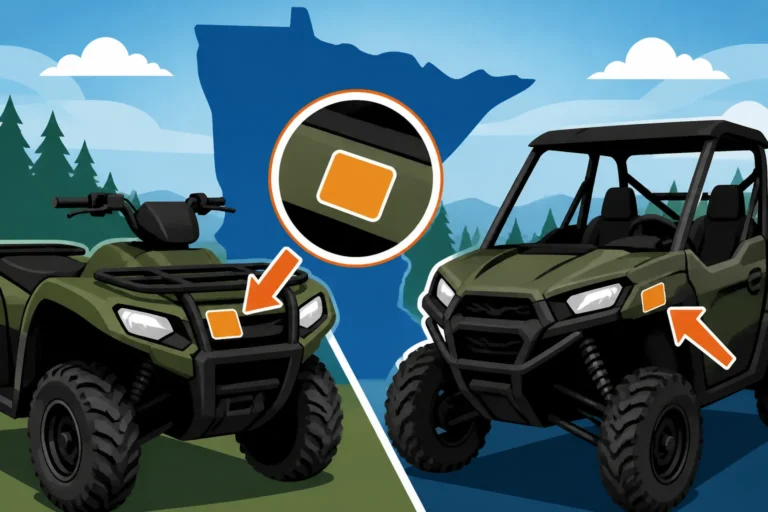
After successfully navigating the paperwork and payment, you'll leave the deputy registrar's office with your new Minnesota ATV or UTV registration card. This card is your official proof that your machine is legally registered in the state, and you should always carry it with you when operating the vehicle on public lands. In addition, you'll receive a set of registration decals or stickers. These stickers have a specific placement requirement on your machine, usually on the upper-right corner of the front fender or cowling, and must be clearly visible. It's not just a decoration; proper placement is essential for enforcement purposes. You can find detailed instructions on [Where a Minnesota ATV Registration Sticker Goes].
Your Minnesota ATV or UTV registration is valid for a three-year period. The expiration date will be clearly printed on your registration card and often indicated by the color of your sticker. As the expiration date approaches, the Minnesota DNR typically sends out renewal reminders to the address on file, but it's ultimately your responsibility to ensure timely renewal. The process for renewal is usually simpler than initial registration, often able to be completed online or through a mail-in option. Planning ahead for your [Minnesota Registration Renewal Every Three Years] will ensure continuous legal operation of your machine.
Navigating Common Hurdles and Special Scenarios
While the general registration process is fairly straightforward, new residents sometimes encounter unique situations or specific questions that can add layers of complexity. It's helpful to be aware of these potential hurdles and how Minnesota addresses them.
What if You Don't Have a Title?
One of the most frequent questions from new residents concerns proof of ownership, especially if they hail from a state that doesn't issue titles for ATVs or UTVs, or if they purchased their machine privately years ago and never received a formal title. Minnesota understands that not all states operate the same way. If you don't have a title, don't despair! The deputy registrar will typically accept alternative forms of proof. This might include a robust bill of sale (even if it's an older one), a notarized affidavit of ownership, or your previous state's registration card. The goal is to establish a clear chain of ownership that satisfies the state's requirements.
If your machine has a particularly murky history, such as being bought without any significant paperwork or from a very informal private sale, the process can become more involved. In these rare cases, you might need to consult with the DNR or a deputy registrar directly to understand what steps, if any, you can take to establish ownership. Sometimes, this might involve a bond or other declarations to ensure the state isn't registering a stolen or disputed machine. For more detailed guidance, especially if your ownership documents are sparse, you'll find resources like [Registering a Minnesota ATV With No Ownership History] incredibly useful. The key is transparency and providing as much verifiable information as you possibly can.
Machines Used on Private Land Only
A common misconception among new residents is that if they only plan to ride their ATV or UTV on their own private property, they don't need to worry about Minnesota registration. While it's true that a machine used exclusively on private land, with no access to or use of public trails, roads, or frozen waters, does not require public use registration in Minnesota, there's a crucial distinction here. This exemption applies strictly to machines that never touch public ground. Even riding across a public ditch to access a different part of your property, or crossing a township road, can be considered public use, triggering the registration requirement.
Moreover, if you ever decide to sell the machine in Minnesota, having it registered makes the transaction much smoother for the next owner. While the law allows for non-registration on entirely private land, many seasoned Minnesota riders still choose to register their machines even if they primarily ride on their own property. This removes any ambiguity and ensures they're covered if their riding habits ever change or if they need to move the machine legally on roads or trails. For a deeper dive into this specific exemption, check out [Registering a Machine Kept Only on Your Own Land] or [Do You Need Registration on Your Own Minnesota Land?]. It's always best to err on the side of caution to avoid potential legal issues.
What About a Trail Pass?
Beyond the state registration of your ATV or UTV, new residents also need to understand the concept of a Minnesota ATV Trail Pass. This is a separate requirement from registration itself. The trail pass is an annual permit that grants you legal access to Minnesota's extensive Grant-in-Aid (GIA) trail system and other public riding areas. Think of registration as permission to own and operate your machine, and the trail pass as permission to use specific public infrastructure built for off-highway vehicles. Even if your machine is registered in Minnesota, you will still need a current trail pass to ride on these designated trails.
For new residents, it's particularly important to grasp that while your out-of-state registration might be honored during the initial 30-day grace period for operation, you would still need to acquire a [Minnesota's Non-Resident ATV Trail Pass] if you plan to ride public trails during that time. Once you're fully a Minnesota resident and your machine is registered here, you'll then purchase the standard Minnesota resident trail pass. These passes are usually purchased annually and must be affixed to your machine in a visible location. Furthermore, remember that registration and trail passes are distinct from safety training requirements. Minnesota has specific [Minnesota's ATV Safety Training Requirement] rules, especially for riders born after a certain date, and for younger riders, which apply regardless of registration status.
Here’s a quick summary of the key documents you’ll likely need as a new resident registering an ATV or UTV in Minnesota:
| Document Type | Purpose | What to Provide (Examples) |
|---|---|---|
| Proof of Ownership | Establishes you as the legal owner of the machine. | Original Title (if issued), Notarized Bill of Sale, Previous State Registration, MCO/MSO |
| Proof of Identity | Confirms who you are. | Valid Driver's License or State ID Card |
| Proof of Residency | Verifies your new Minnesota address. | Minnesota Driver's License, Utility Bill, Lease Agreement, Bank Statement |
| Payment for Fees | Covers registration fees and potential use tax. | Check, Credit Card, or Cash (confirm acceptable payment methods with registrar) |
| Registration Form | Official application for Minnesota OHV registration. | Provided at the Deputy Registrar's Office |
Disclaimer
This article is for general informational purposes only and does not constitute professional advice. Laws, prices and regulations vary by location and change over time. Consult a qualified professional for guidance on your specific situation.