Tying a Machine Down for the Interstate
The open road calls, and with it, the promise of adventure on your ATV or UTV. But let's be honest, that feeling of freedom can quickly be overshadowed by a nagging worry: is my pride and joy really secure back there? The thought of a thousand-pound machine wiggling loose at highway speeds, especially when you're barreling down the interstate, is enough to make any rider's stomach churn. It's not just about protecting your investment; it's about the safety of everyone sharing the road with you. This isn't just a guide on straps; it's about giving you the confidence to tow your machine safely and legally across Minnesota and beyond, ensuring peace of mind from your driveway to the dirt trails.
Why Proper Tie-Downs Are a Non-Negotiable Necessity
You might think, "It's just a short drive," or "I'll take it easy." But the truth is, accidents happen, and the stakes are incredibly high when you're hauling several hundred to over a thousand pounds of raw power on a trailer. Securing your machine isn't just a suggestion; it's a critical safety measure and a legal requirement that protects not only your machine but also other drivers and your own financial well-being.
Safety for Everyone on the Road
Imagine cruising down I-35 near Forest Lake, a semi-truck breezes past, and suddenly your trailer experiences a buffeting crosswind. If your ATV isn't rock-solid, even a slight shift can put immense strain on your tie-downs, or worse, cause the machine to break free. An unsecured ATV or UTV becoming road debris is a catastrophic scenario. It can cause other drivers to swerve violently, leading to multi-vehicle collisions, serious injuries, or even fatalities. You could face incredibly severe legal consequences, from heavy fines and points on your license to criminal charges, depending on the outcome of an accident. The liability implications alone are enough to make anyone double-check their setup. No adventure is worth risking someone's life over a few minutes saved on proper securing. When you are hauling any off-highway vehicle, you are responsible for the entire load, and any failure on your part means potential disaster for many.
It's also about preventing smaller, yet still dangerous, incidents. A shifting load can cause your trailer to sway uncontrollably, especially at highway speeds, making it incredibly difficult to maintain control of your tow vehicle. This "trailer sway" can lead to jackknifing, losing control, and even flipping your entire rig. Even if the machine doesn't come completely off the trailer, a loose strap flapping in the wind can distract other drivers, or worse, come undone and become a projectile. Think about the peace of mind you get from knowing you've done everything in your power to prevent such incidents; it's priceless when you're putting miles under your wheels.
Protecting Your Investment and Avoiding Unnecessary Costs
Let's face it, ATVs and UTVs aren't cheap. Whether you're towing a brand-new Polaris Ranger or a seasoned Yamaha Grizzly, you've invested significant money and likely countless hours into it. An improperly secured machine can suffer serious damage, even if it never leaves the trailer. Bouncing and shifting can lead to scratches, dents, bent axles, damaged suspension components, or even frame issues. Over time, the constant movement can wear down paint, chafe wiring, or even stress crucial parts of your machine simply from the vibrations and bumps of the road. Protecting that investment starts with proper tie-down techniques.
Beyond the damage to your machine, there's the cost of tickets and potential insurance headaches. Law enforcement officers, especially Minnesota State Patrol troopers, are trained to spot unsafe loads. If they deem your setup unsafe, you could be pulled over, issued a hefty citation for an unsecured load, and forced to re-secure your machine on the spot, delaying your trip significantly. In some cases, if the issue is severe enough, they might even order you off the road until the situation is rectified, perhaps even requiring a tow. And if damage occurs because of inadequate tie-downs, your insurance company might deny a claim, leaving you to foot the entire bill for repairs or replacement. It’s a frustrating situation that’s entirely preventable with a little foresight and effort. For insights into related costs, you might find [Minnesota ATV Insurance Cost] useful.
Choosing the Right Tie-Down Equipment for Your Haul
Securing your ATV or UTV isn't a one-size-fits-all endeavor. The type of machine you're hauling, the trailer you're using, and the distance you're traveling all play a role in selecting the appropriate gear. Skimping on tie-downs is like building a house on a shaky foundation – it's just asking for trouble down the line.
Types of Straps and Their Uses
When you head to the hardware store or an outdoor outfitter, you'll be faced with a dizzying array of tie-down options. For ATVs and UTVs, the main contenders are ratchet straps, cam buckle straps, and specialized wheel nets.
-
Ratchet Straps: These are the workhorses of the tie-down world, and for good reason. They allow you to apply significant tension, cinching your machine down tightly. You'll typically find them in widths from 1 to 2 inches, with varying load capacities. For ATVs, 1-inch straps with a breaking strength of at least 1,500 pounds (often referred to as a "working load limit" or WLL of 500 lbs) are usually sufficient for each strap, but for heavier UTVs, or if you prefer extra security, 2-inch straps with higher ratings are a much better choice. The key is to check the working load limit (WLL) – this is the maximum weight a strap can safely hold during use, usually one-third of the breaking strength. Don't cheap out here; a few extra dollars for a higher WLL can save you thousands in potential damages. They're ideal for compressing suspension and holding the machine firmly in place for extended highway travel.
-
Cam Buckle Straps: These straps are designed for lighter loads where over-tightening could cause damage, or where quick release is desired. They use a spring-loaded buckle that bites down on the strap, holding it in place without the mechanical advantage of a ratchet. While great for securing lighter gear in a truck bed or on a roof rack, they typically aren't robust enough for the primary tie-down of a heavy ATV or UTV, especially not for interstate travel. They lack the holding power to compress suspension effectively and are more prone to slipping under extreme vibration or significant force. Think of them as secondary restraints or for securing smaller accessories, not your main lines of defense against your quad taking flight.
-
Wheel Nets/Chocks: These are arguably the most secure method for tying down an ATV or UTV because they secure the tires directly, effectively pinning the machine to the trailer. They typically consist of a strap system that wraps over or around the tires, connecting to anchor points on the trailer. By securing the wheels, you eliminate almost all up-and-down movement and prevent lateral shifting. This method keeps the machine's suspension working naturally, avoiding the potential for "suspension bounce" that can loosen traditional over-the-frame straps. If you frequently haul long distances or on rough roads, investing in a set of quality wheel nets can provide unparalleled peace of mind. Combine these with one or two ratchet straps over the frame for redundancy, and you've got a virtually unshakable setup.
Anchoring Points: Where to Cinch It Down
Just as important as the straps themselves are the points you attach them to. Both on your trailer and on your machine, you need strong, reliable anchor points that are designed to handle significant force.
-
Trailer Anchors: Your trailer should ideally have sturdy D-rings, E-track, or L-track systems firmly bolted to the frame. D-rings are common and highly versatile. E-track and L-track systems offer multiple attachment points along the length of the trailer, allowing for flexible positioning of your tie-downs. Never use flimsy, rusty, or aftermarket anchor points that aren't securely fastened to the trailer's structural frame. If your trailer lacks adequate points, consider having a reputable shop install proper ones. Remember, the weakest link in your tie-down system is where it will fail. Information on [Trailer Registration for Hauling ATVs in Minnesota] can help ensure your trailer is road-ready.
-
Machine Anchors: On your ATV or UTV, look for factory-designated tie-down points. These are usually strong, load-bearing parts of the frame, solid suspension components, or even dedicated loops. Avoid wrapping straps around plastic body panels, brake lines, electrical wiring, or anything that could be crushed, cut, or damaged by the tension. Axles are often good, sturdy points, but be careful not to pinch brake lines or wiring. Many riders opt to run straps through the wheels themselves, using the sturdy spokes or hub as anchor points, being mindful of brake calipers and rotors. The goal is to distribute the force evenly and connect to the most robust parts of your machine. When considering [Two Quads on One Trailer Deck], proper anchor point utilization becomes even more crucial for spacing and security.
Trailer Considerations: Your Mobile Foundation
Your trailer is the foundation upon which your entire hauling operation rests. Its condition, weight rating, and how you load it are paramount. Before you even think about tying down your machine, inspect your trailer thoroughly. Check tire pressure, lug nuts, lighting, and the overall structural integrity.
Make sure your trailer's Gross Vehicle Weight Rating (GVWR) is sufficient for the combined weight of your ATV/UTV(s) and the trailer itself. Overloading your trailer is incredibly dangerous, affecting braking, handling, and putting undue stress on axles, tires, and frame. Also, pay attention to tongue weight – the downward force exerted on your hitch. Too little tongue weight (usually 10-15% of the total loaded trailer weight) can cause severe trailer sway, while too much can overload your tow vehicle's rear suspension. Center your machine over the trailer axles to achieve proper weight distribution. Knowing [Minnesota Trailer Plate Cost] and whether [Do You Need a Trailer Title in Minnesota?] are important legal aspects of trailer ownership.
The Art of Securely Strapping Your Machine for the Long Haul
Simply throwing a few straps over your ATV or UTV isn't enough. There's a method to the madness, a specific "art" to ensuring your machine is truly immovable, even when facing bumps, turns, and sudden stops. It's about creating a comprehensive, redundant system that works with the physics of towing, not against it.
Strategic Placement on the Trailer
Before any straps even come out, the initial placement of your machine on the trailer is critical. Always aim to center your ATV or UTV as much as possible, both side-to-side and front-to-back. The ideal spot is typically with the majority of the machine's weight slightly forward of the trailer's axle(s). This ensures proper tongue weight, which, as mentioned before, is vital for stable towing and preventing dangerous sway.
For a single machine, this usually means positioning it so that the front tires are just a bit ahead of the axle centerline. If you have multiple machines, like if you're hauling [Two Quads on One Trailer Deck], you'll need to carefully consider the combined weight distribution. Sometimes, this requires loading one machine facing forward and another backward to balance the load, or alternating their positions for optimal tongue weight. Never have too much weight concentrated at the very back of the trailer, as this severely reduces tongue weight and makes the trailer prone to fishtailing, which is incredibly dangerous at highway speeds.
The X-Pattern and Beyond: Redundancy is Key
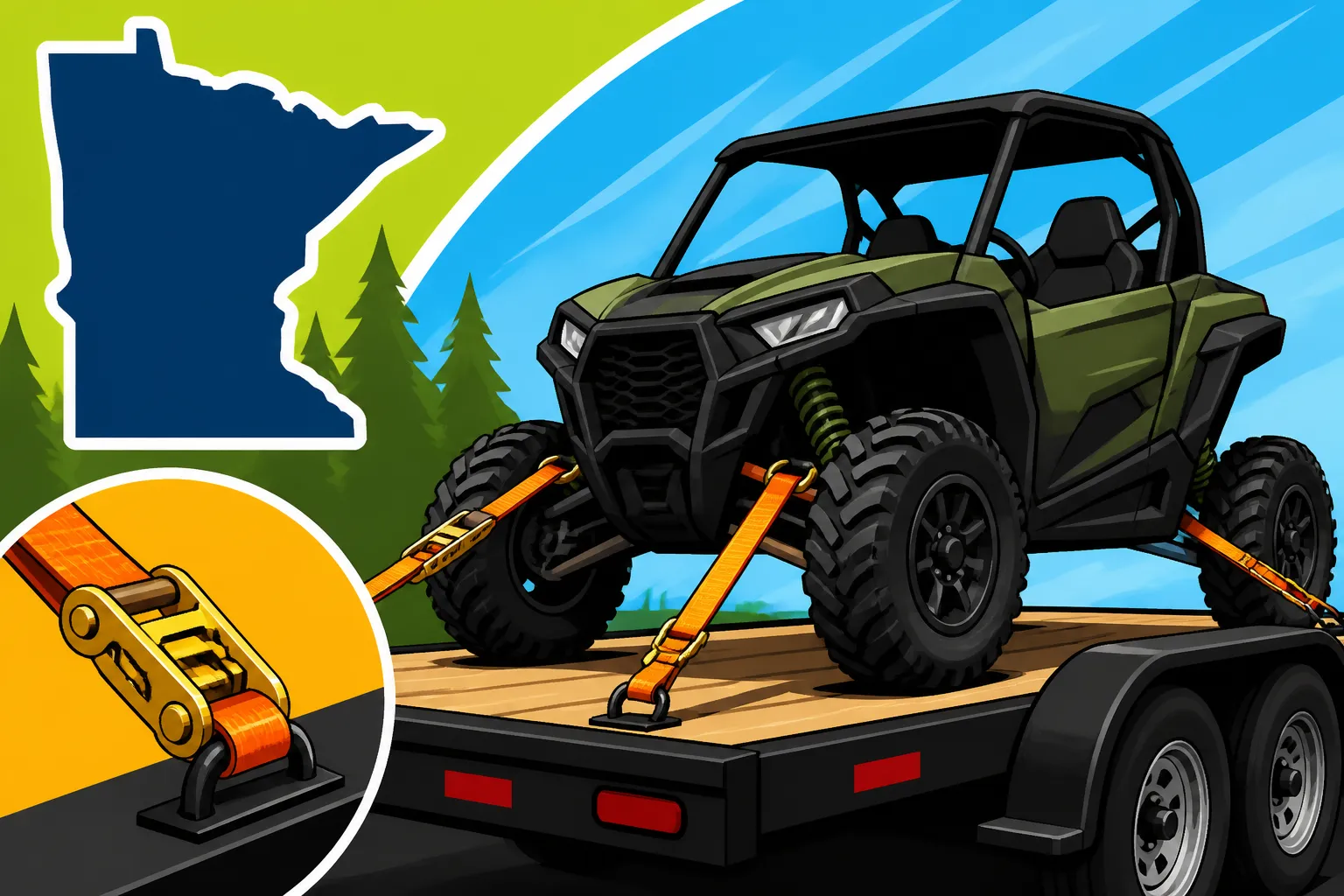
The "X-pattern" is a foundational technique for securing a load, and it's particularly effective for ATVs and UTVs. This involves running straps from the front left of your machine to the front right anchor point on the trailer, and from the front right of the machine to the front left anchor point on the trailer. Repeat this X-pattern at the rear of the machine. This creates opposing forces that prevent both forward, backward, and side-to-side movement.
However, for interstate travel, where you'll encounter varying road conditions, wind gusts, and potentially emergency braking, redundancy is paramount. I always recommend using at least four robust ratchet straps – two for the front and two for the rear – each forming part of an X-pattern or running directly from a strong point on the machine to a strong point on the trailer. For heavier UTVs, or if you're particularly cautious, adding two more "straight" straps (one at the front, one at the rear, running directly forward/backward) can provide extra security. Think of it as a belt-and-suspenders approach: if one system fails, another is there to back it up.
Compressing the Suspension for Stability
This is a step many new haulers miss, but it's crucial for stability. Your ATV or UTV's suspension is designed to absorb bumps and flex. While riding, that's great. While trailering, it can work against you. As you hit bumps, the suspension can compress and rebound, causing the machine to "bounce" on the trailer. This bouncing can loosen your straps over time, reducing their tension and allowing the machine to shift.
To prevent this, use your ratchet straps to slightly compress the machine's suspension. You don't need to bottom it out completely, but you should cinch the straps down enough so that there's a noticeable resistance when you try to rock the machine manually. This pre-loads the suspension, minimizing its movement during transit and keeping your straps taut. When tightening, always alternate between straps (front left, then front right, then rear left, then rear right) to apply even pressure and prevent the machine from twisting or tilting. For a smoother ride, it also helps to think about how you approach [Loading a Machine on a Gravel Shoulder] to ensure a level base for strapping down.
Pre-Trip Checks and On-the-Road Best Practices
Even with the best equipment and strapping techniques, the journey isn't over until your machine is safely unloaded. A secure haul requires vigilance, both before you leave and throughout your drive. This final stage is about preventing surprises and reacting safely if issues arise.
The "Wiggle Test" and Visual Inspection Ritual
Before you even pull out of the driveway, perform a thorough "wiggle test." Grab your ATV or UTV and try to forcefully rock it in every direction – forward, backward, and side-to-side. It should feel absolutely solid, with no discernible movement on the trailer bed. If there's any play, even slight, re-tighten your straps and repeat the test until it's perfectly stable. This is your last chance to catch an issue before highway speeds amplify any problems.
But the vigilance shouldn't stop there. Make a habit of visually inspecting your tie-downs every time you stop for gas, a break, or at least every couple of hours on long trips. Look for any signs of loosening, chafing, or damage to the straps. Are they still taut? Is the buckle still locked securely? Are the hooks still fully engaged with the anchor points? Even perfectly secured loads can shift slightly due to road vibrations, temperature changes, or unexpected braking maneuvers. A quick walk-around can identify a loose strap before it becomes a major problem. It’s also good practice to ensure your tow vehicle and trailer are properly insured, as detailed in [Minnesota Liability Insurance for Riders].
What to Do If a Strap Loosens Mid-Trip
It happens to the best of us: you glance in your mirror and notice a strap looks a little slack, or worse, you hear an unfamiliar flapping sound. Your first instinct might be to panic, but the key is to react calmly and safely. Do NOT attempt to adjust straps while driving or pull over in a dangerous location. Activate your turn signal, find the nearest safe place to pull off the road – a rest area, a wide shoulder, or an exit ramp with ample space – and bring your vehicle to a complete stop.
Once safely off the road, engage your parking brake, put on your reflective vest if you have one, and carefully inspect the situation. Identify which strap has loosened and why. Was it not tight enough initially? Did a bump cause it to slip? Is the strap itself damaged? Re-tighten or replace the problematic strap. If a strap is frayed or cut, do not trust it for the remainder of the trip; replace it with a spare you should always carry. Never try to "make do" with a compromised strap. It's better to take an extra 15-20 minutes to resolve the issue properly than to risk a catastrophic failure down the road. If you encounter any incidents, knowing about [Minnesota ATV Crash Reporting] is crucial.
Dealing with Long Hauls and Inclement Weather
Interstate travel often means long hours and exposure to unpredictable weather. Wind, rain, snow, and extreme temperatures can all impact your tie-down system. Strong crosswinds, particularly common in open areas of Minnesota, can exert immense force on your machine and trailer, testing the limits of your straps. Heavy rain or road spray can cause straps to stretch slightly, while freezing temperatures can make them stiff and brittle.
For extended trips, consider using strap covers or protectors wherever a strap might rub against a sharp edge on your machine or trailer. These sleeves, often made of durable fabric or rubber, prevent chafing and extend the life of your straps. In heavy rain, keep a closer eye on your straps, as they can sometimes "creep" or stretch slightly when wet. For legal peace of mind, especially if you're ever questioned about your setup, having a clear understanding of what you're doing is key. For more formal documentation needs, if you're drawing up agreements for shared hauls or lending out a machine, resources like LawDepot can assist with various legal templates. Similarly, if you're curious about specific regulations, be aware that you can face [Minnesota Fines for Illegal Road Riding] or [Minnesota Penalties for Reckless Riding] if your setup isn't up to par. Taking the extra steps to ensure everything is secured properly will make your journey much less stressful and significantly safer.
| Strap Type | Primary Use Cases | Pros | Cons | Ideal for |
|---|---|---|---|---|
| Ratchet Straps | Heavy loads, securing ATVs/UTVs, compressing suspension | High tension capability, very secure, versatile | Can over-tighten/damage items, can be slow to release, buckles can rust | Main ATV/UTV tie-down for highway/interstate travel |
| Cam Buckle Straps | Lighter loads, quick adjustments, delicate items | Easy to use, quick release, less risk of over-tightening | Lower load capacity, prone to slipping with heavy vibration/force | Secondary restraints, gear in truck bed, light cargo |
| Wheel Nets | Securing vehicle wheels directly | Extremely secure, no suspension compression needed, prevents shifting | Can be more expensive, specific to wheel size, might require specific trailer anchors | Ultimate security for ATVs/UTVs, long hauls, rough roads |
Disclaimer
This article is for general informational purposes only and does not constitute professional advice. Laws, prices and regulations vary by location and change over time. Consult a qualified professional for guidance on your specific situation.