Enforcement and Checkpoints in Minnesota
Enforcement and Checkpoints in Minnesota
A trail stop can turn a good ride stressful if your registration, pass, safety certificate, or machine setup is not in order. Minnesota enforcement may happen on trails, at trailheads, or during focused patrols, and the exact requirements depend on where and how you ride. Knowing what officers may check—and how to respond calmly—helps you prepare without treating every encounter like a citation.
What Enforcement and Checkpoints Can Look Like
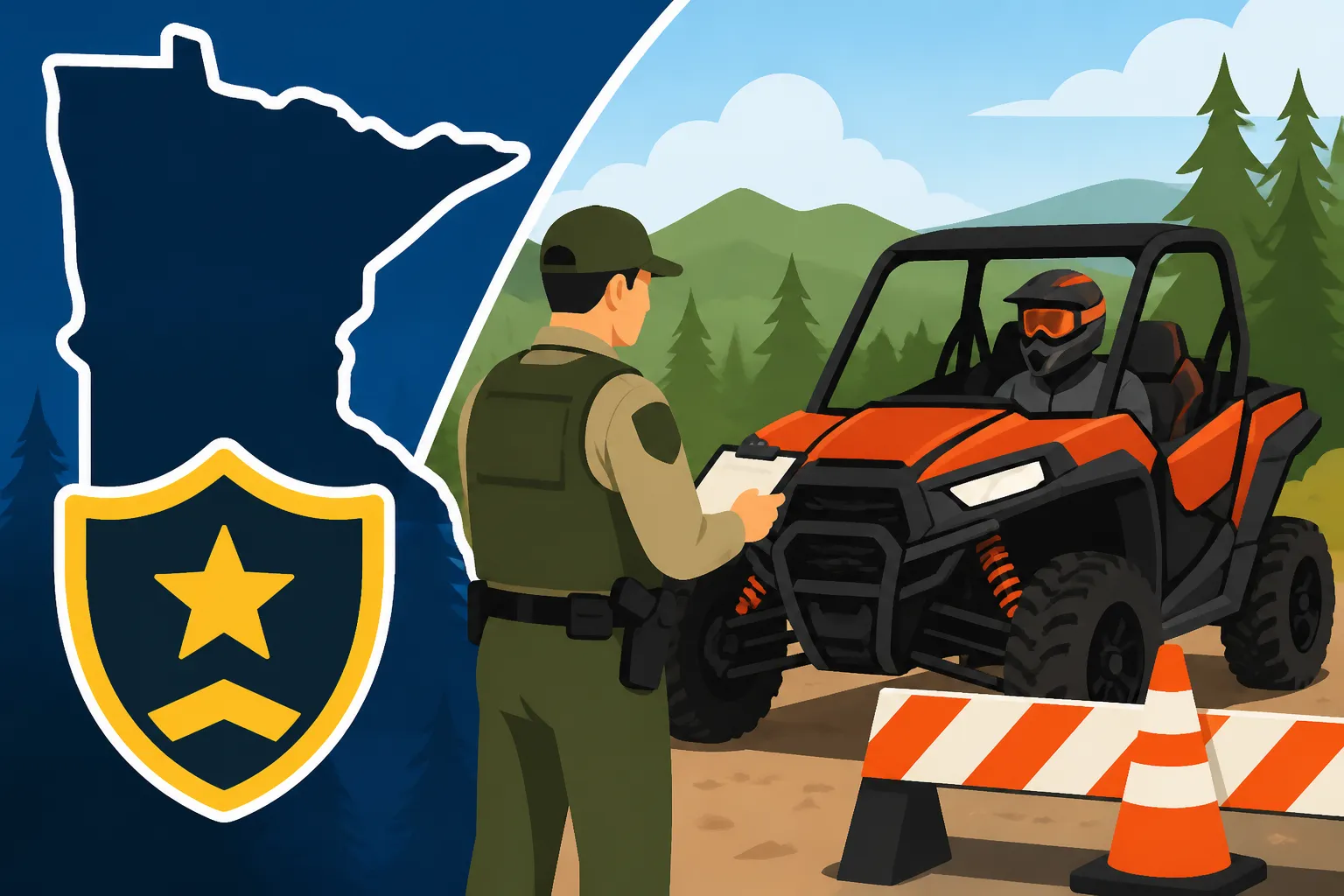
Minnesota ATV enforcement is not limited to a single kind of checkpoint. You might see an officer moving along a trail, speaking with riders at a staging area, or checking machines where a trail meets a road. Enforcement activity may focus on a particular area or concern, such as unsafe riding, access restrictions, trail damage, or permit compliance.
A uniformed officer’s presence does not automatically mean every rider is in trouble. An encounter may involve a brief check, a safety reminder, questions about your route, or a closer look at documents and equipment. If an officer identifies a violation, the outcome can depend on the facts, the applicable rule, and the officer’s judgment. A checkpoint is not a guarantee that you will receive a citation, but it is a good reason to have your paperwork and machine ready.
Conservation officers enforce natural-resource and recreational-vehicle rules. Other law enforcement officers may also be present, depending on the location and the issue. Their responsibilities and authority can differ, so do not assume that every uniformed person is checking the same things or enforcing the same rules.
Places you may encounter a check
Checks can happen in places where riders naturally gather or where access can be verified. These may include:
- Trailheads and parking or staging areas
- Designated trails and connecting routes
- Points where trails cross roads or enter public land
- Areas with posted restrictions or seasonal closures
- Organized events or busy riding areas
- Locations where officers are responding to a complaint, crash, or report of damage
A check may also follow a specific incident. For example, an officer might speak with nearby riders after a reported collision, unsafe operation, or suspected trespass. That does not necessarily mean every person present is accused of wrongdoing. Stay calm, answer questions clearly, and avoid making guesses about what happened.
Do not treat a trailhead as a boundary beyond which enforcement cannot occur. If you ride from a parking area onto a route, the rules for that route still apply. Likewise, a machine parked on a trailer may be treated differently from one being operated, but riding it onto a trail can trigger the requirements for that riding area. If you are unsure whether your planned route is open or what permits it requires, check before unloading. Checking Minnesota Trail Status Before You Drive
Why enforcement may be focused in one area
Patrol patterns can change with conditions and local concerns. A heavily used route may draw attention because riders are operating unsafely, leaving the designated trail, ignoring a closure, or causing damage. A check may also be part of an effort to explain rules to visiting riders or prevent repeat problems.
Do not read a temporary absence of officers as permission to take a shortcut or ignore a sign. Trail access can depend on land ownership, the route’s designation, the season, and posted restrictions. When a trail is closed, a pass or valid registration does not override that closure. Minnesota Permit Rules on Grant-in-Aid Trails
What Officers May Check
A roadside or trail stop can involve several different requirements. Not every item applies to every rider or machine. Registration, trail permits, safety training, age-related restrictions, and equipment rules can depend on the machine type, the operator, the route, and whether you are a Minnesota resident or a visitor.
The key is to keep the categories separate. A registration record is not necessarily the same thing as a trail permit, and a trail permit does not make a closed route open. A safety certificate, where required, is about the rider; it is not a substitute for the machine’s registration or the route’s access requirements.
| What may be checked | Why it matters | What to do before riding |
|---|---|---|
| Machine registration and decal | The machine may need current registration for the way and place it is being used | Confirm the machine’s category, use, and registration status |
| Trail pass or permit | Some routes and riders require a separate permit | Check whether the requirement applies to your residency, machine, and route |
| Operator age and safety certification | Age and training rules may apply to riders on public riding areas | Verify the current rule for the operator’s age and experience |
| Route access and closures | A valid registration or pass does not authorize riding on a closed or prohibited route | Read signs and check current trail conditions |
| Required safety equipment | Requirements can depend on age, machine, time, and location | Check current rules and inspect gear before departure |
| Safe operation | Reckless riding, impaired operation, or unsafe passenger use can create enforcement and injury risks | Ride within your ability and follow posted restrictions |
| Damage or trespass | Leaving the route can affect land, wetlands, and other users | Stay on designated routes and obtain permission before using private land |
Registration is not the same as a trail pass
Riders sometimes assume that a current registration sticker covers every permit requirement. It may not. Registration concerns the machine and its legal status; a trail pass or other permit may apply to a particular rider, machine, or riding area. The details vary, especially for people visiting from another state.
Minnesota residents and nonresidents should not assume they have identical requirements. Nor should a visitor assume that an out-of-state registration automatically satisfies every Minnesota trail rule. Check the rules for the specific machine and route before traveling. Minnesota Rules for Visiting Riders Minnesota’s Non-Resident ATV Trail Pass
If you are uncertain whether your machine needs a trail pass, review the route information and the rules for that kind of machine. A machine used only on private land may be treated differently from one operated on a public trail, but crossing onto a public route can change the analysis. When a Minnesota Rider Needs No Trail Pass
Keep proof organized
Before a ride, make sure you can locate the records that apply to you. Depending on your situation, that may include registration information, a required pass, proof of safety certification, or insurance information. Rules about what must be carried or displayed can differ, so confirm the current requirement rather than relying on what another rider does.
Keep documents protected from water and easy to reach. A small waterproof pouch can help prevent a soggy paper record from becoming unreadable. If a permit must be displayed on the machine, check the placement and visibility rules rather than assuming that a receipt in your pocket is enough. Carrying the Pass While You Ride
A phone can be useful for storing copies or finding information, but do not rely on a dead battery, weak signal, or a screenshot that does not prove what you think it proves. If an official rule calls for a particular display or document, follow that rule. Use your phone as a backup, not as a substitute for checking what is required.
Safety training is another item to check well before the ride. Requirements may depend on a rider’s age and where the machine is operated. If you are riding with a child or teenager, verify the current requirements for both the operator and any passenger. Minnesota’s ATV Safety Training Requirement
How to Handle a Stop or Checkpoint
A calm, practical response is usually the best approach. Stop where directed, keep the machine under control, and give the officer time to explain the reason for the check. If the officer asks you to turn off the engine or move the machine, follow the instruction when it is safe to do so.
A checkpoint can feel abrupt, especially when a group arrives together. Avoid crowding the officer or moving around while another rider is being spoken to. If you are riding in a group, let one person handle the conversation for a particular machine unless the officer asks another rider a question.
A straightforward response
- Stop promptly and safely. Slow down, give other riders room, and pull over where indicated. Do not speed away, try to bypass the check, or make a sudden turn that could look like an attempt to avoid contact.
- Make the machine safe. Keep control of the vehicle. If asked, turn off the engine and remain seated or dismount as directed.
- Listen before answering. Let the officer finish explaining the request. If you do not understand, ask politely for clarification.
- Provide the information or documents requested. Keep relevant records easy to reach, but tell the officer before reaching into a bag or compartment.
- Answer accurately and briefly. If you do not know an answer, say so rather than guessing or giving a long explanation that creates confusion.
- Ask what you need to do next. If there is a compliance issue, ask what requirement is missing and whether you may continue after addressing it.
- Handle a citation separately from the roadside conversation. If you disagree with an alleged violation, stay respectful and use the process described on the citation or by the court. Do not argue aggressively at the trail.
This approach does not mean you must agree with every statement made during a stop. It means you can keep the encounter orderly while preserving the option to question a citation through the appropriate process. If you believe an officer misunderstood a fact, explain the fact calmly and show relevant documentation if requested.
If you do not have a document
Do not invent an excuse or claim you have a permit that you cannot produce. Explain what you have, what you believe applies, and whether you can retrieve another record. Ask the officer what the current requirement is and what options are available. An officer may decide how to handle the situation based on the circumstances; there is no safe way to promise that a missing record will be excused.
If your phone has no service, say so. Do not leave the scene to find a signal unless the officer tells you to. If a passenger or another person has the needed record, ask before reaching for their phone or bag, and make sure the officer understands what you are doing.
When a registration decal is missing or damaged, explain the situation plainly. A receipt or record may help establish what you purchased or renewed, but do not assume it replaces a required decal. Check the current replacement procedure before the next ride. Minnesota Penalties for a Missing Sticker
If you receive a citation
Read the citation before leaving so you understand the alleged violation, the location, and any response instructions. Keep the paperwork in a safe place and note the date, time, route, weather, and any facts you may need later. If other riders witnessed the encounter, record their contact information with their permission.
Do not rely on an informal roadside statement as a final ruling on the case. If the citation raises a legal or financial concern, contact a qualified professional or use the court process identified in the paperwork. Whether a citation can be challenged successfully depends on the facts and the applicable law.
If you believe the officer’s conduct was improper, separate that concern from the citation process. Write down what occurred while your memory is fresh, keep copies of relevant documents, and use the appropriate official complaint process. Avoid posting personal accusations or another person’s private information online.
Common Compliance Problems and How to Prevent Them
Many enforcement problems begin before a rider reaches the trail. A machine may have paperwork that belongs to a previous owner, a sticker that is hard to see, or a permit that applies to a different route. Riders can also unintentionally rely on an assumption that was true for one machine or one location but not another.
Assuming one permit covers everything
Registration, a trail pass, safety certification, insurance, and route access are different questions. A rider can have one item in order and still be missing another that applies to the ride. Before leaving home, ask:
- Is this machine currently registered for the way I plan to use it?
- Does this route require a separate trail pass or permit for me?
- Does the operator need a safety certificate?
- Is the route open to this machine type today?
- Are there age, passenger, or safety-equipment rules that apply?
The answers may differ between a public trail, private land, a road connection, and a route with temporary restrictions. For a broader checklist, see What Minnesota Riders Need Before They Ride.
Riding with an unreadable or misplaced decal
A registration decal can be present but difficult to identify if it is covered in mud, placed where a body panel blocks it, or damaged by weather. Clean the display area and inspect the decal before a trip. Follow the current placement instructions for your machine type; do not copy another vehicle’s placement if the models differ.
If the sticker has fallen off, do not assume that showing an old photo will settle the issue. Find out how to replace it and what proof, if any, you should carry while waiting. Replacing a Minnesota ATV Decal That Fell Off
Relying on another state’s paperwork without checking Minnesota rules
A visitor may arrive with a home-state registration and assume it grants the same access as a Minnesota registration or pass. That can be a costly misunderstanding. The requirements can depend on the rider’s residency, the machine, the riding location, and the type of permit. Confirm the Minnesota rules before your trip, especially if you plan to use a state or grant-in-aid trail.
Likewise, do not assume Minnesota registration will automatically satisfy requirements elsewhere. When travel crosses a state line, check the destination’s rules before riding. Reciprocity Minnesota Does Not Offer
Treating a private-land exemption as permission to use public trails
A rule that applies to a machine used only on private land does not necessarily apply once you ride onto a public trail or other regulated area. Permission from a landowner is also not the same as permission to use adjoining public land. Make sure you know where the property boundary is and whether your route crosses it.
If your plan includes riding from a cabin, farm, or hunting property to a public route, confirm the requirements for the entire trip. Do not assume that a short connection or a ride on a familiar path is automatically exempt.
Ignoring signs, closures, or changing conditions
A valid pass does not override a temporary closure, a posted restriction, or a route that does not allow your machine. Trail conditions can change after rain, during seasonal transitions, or after damage. A route shown on a map may not be open for your intended use at the time you arrive.
Check current information before travel and watch for signs at the trail. If signs conflict with an old map or a saved route, do not assume the map takes priority. Turn around if necessary and find a legal route rather than continuing until an officer stops you.
Riding in a way that draws attention for the wrong reason
Some enforcement encounters start with behavior that is visible from a distance: excessive speed, riding off the marked route, unsafe passing, carrying an improper passenger, or operating near people and homes without slowing down. Even when a rider has all the right paperwork, unsafe operation can still create a separate problem.
Ride predictably. Give pedestrians and other machines space, keep to the designated route, and slow down where visibility is limited. Avoid alcohol or other impairment before operating. If a machine is not designed for a passenger, do not carry one simply because the seat seems wide enough.
Preparing a group before the ride
A group leader can reduce confusion by checking each machine and rider before departure. Do not assume the lead rider’s papers cover everyone else. Each operator should know what applies to their machine and be able to find the relevant records.
A quick pre-ride check can include:
- Confirming each machine’s registration and visible decal
- Checking whether each rider needs a trail pass
- Verifying applicable training and age requirements
- Reviewing route access and current closures
- Making sure riders know where to stop if the group is checked
- Agreeing not to leave the route or separate from the group without a plan
For organized rides, clubs, or guided trips, check any event-specific requirements in advance. The rules for an event may include additional conditions beyond the ordinary requirements for an individual ride.
Frequently Asked Questions
Can an officer stop an ATV on a Minnesota trail?
An officer may contact riders while enforcing applicable rules or responding to a safety concern, report, or incident. The exact circumstances and authority depend on the situation. Stop safely, follow directions, and ask politely if you do not understand what is being requested.
Does having Minnesota registration mean I do not need a trail pass?
Not necessarily. Registration and a trail pass are separate requirements. Whether a pass applies depends on the rider, machine, and route, so confirm the rules for your specific trip.
Can I ride away if I do not have my documents with me?
Do not leave or bypass an active stop. Explain what you have and ask the officer what to do next. Whether a record shown later will resolve the issue depends on the circumstances and the applicable rules.
Will every checkpoint result in a ticket?
No. A check may be brief, educational, or focused on verifying a requirement. If an officer identifies a violation, the response will depend on the facts and the rule involved.
Can a trail pass let me ride through a closure?
No. A pass does not cancel a closure or authorize use of a route that is prohibited for your machine. Check current trail status and follow posted signs.
Disclaimer
This article is for general informational purposes only and does not constitute professional advice. Laws, prices and regulations vary by location and change over time. Consult a qualified professional for guidance on your specific situation.