Family-Friendly Minnesota ATV Trails
A family ride can go sideways quickly when a trail is too narrow for a side-by-side, a child gets tired miles from the truck, or spring conditions close the route you planned to use. This guide explains how to choose family-friendly Minnesota ATV trails, match a route to your riders and machines, and prepare for a safer, more comfortable day.
What makes a Minnesota ATV trail family-friendly
Look beyond the trail name
“Family-friendly” is not a formal difficulty rating, and a trail that works well for one family may be a poor fit for another. A short, familiar route can be a good first outing for younger riders, while a longer loop with changing terrain may suit a family with experienced teens. Consider your group’s riding ability, stamina, machine types, and comfort with navigation before picking a destination.
Pay attention to more than distance. Trail width, surface, hills, mud, rocks, water crossings, blind corners, and the availability of nearby staging areas all affect how manageable a ride feels. A route that is easy for an adult on a full-size ATV may be challenging for a new rider on a smaller machine, especially if the group has to keep moving to stay together.
Think about what happens if the plan changes. A child may need a break, a machine may develop a problem, or weather may turn unpleasant. Routes with straightforward access points and reasonable options for turning back are easier to manage than rides that depend on completing a long loop. Before heading out, review [Minnesota Trail Difficulty Ratings] and [Family-Friendly Minnesota ATV Trails] alongside current local trail information.
Match the route to every machine in the group
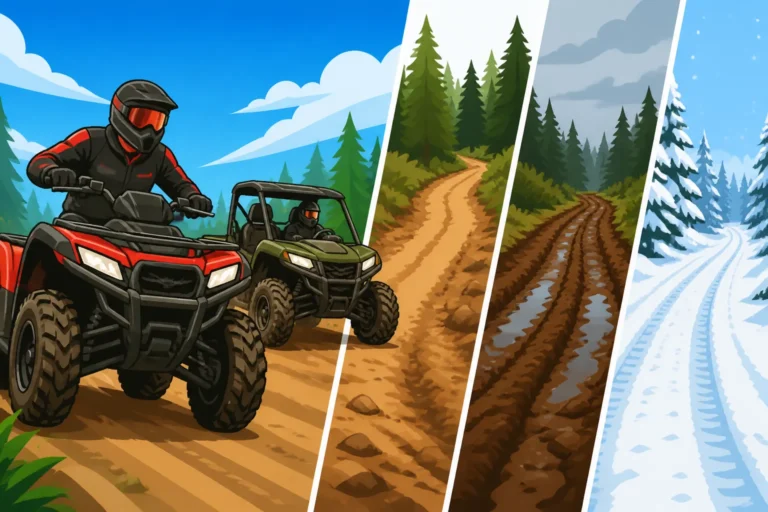
A family ride often includes different machines: a youth ATV, an adult ATV, and perhaps a side-by-side. That variety matters. Some trail segments may have width restrictions or other rules that affect which machines can use them. Never assume that a route is suitable for a side-by-side just because it is open to ATVs generally.
Check each machine’s width and the trail system’s posted requirements before traveling. This is particularly important if you have a full-size side-by-side, an especially wide setup, or aftermarket accessories that change the machine’s dimensions. A family can arrive at a trailhead with a carefully planned day and discover that one vehicle in the group cannot use the route.
Machine fit also affects how comfortable younger riders feel. A wide, stable side-by-side may be a sensible choice for some families, but it is not automatically the best tool for every trail. A narrow route, tight turn, or rough section may be easier on a smaller ATV. If your group has mixed machines, plan around the most restricted vehicle and confirm that the entire route works for everyone.
Minnesota trail areas to consider for a family ride
Spider Lake and the Foot Hills Forest
Spider Lake Trails in the Foot Hills Forest near Pine River are one option for families exploring central Minnesota. As with any forest trail network, conditions and route character can vary by segment. Review the map before you go, choose a conservative route for less-experienced riders, and avoid treating the entire network as if it has one consistent level of difficulty.
Families may appreciate having a broader trail area to explore, but more choices also call for more planning. Decide where you intend to ride, identify a reasonable turnaround point, and make sure everyone understands the group’s pace. A route that looks short on a map can take longer when children need breaks or riders move slowly through rough sections.
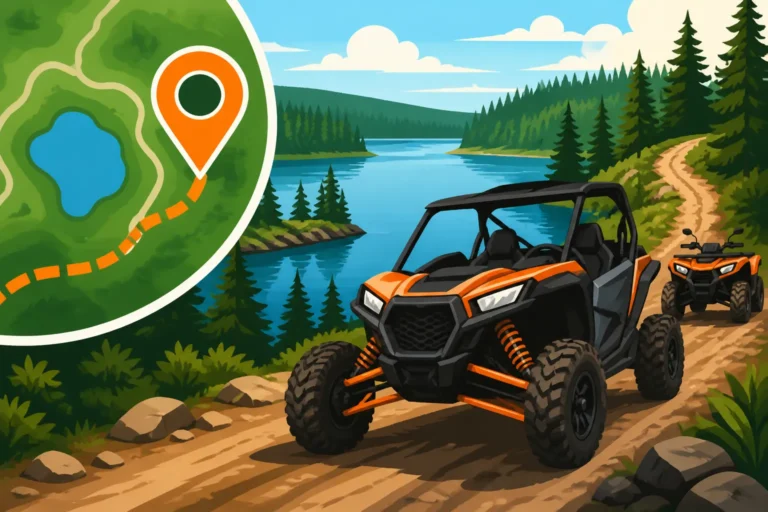
If this is your first visit, keep the day modest. Start with a route that lets you learn the trail markings and local riding conditions before committing to a longer outing. Use a current map or navigation tool such as onX Offroad as a planning aid, but also pay attention to signs and closures on the ground. A phone map is not permission to ride a closed or restricted route.
Soo Line North and the Paul Bunyan Forest
The Soo Line North Trail and trails in the Paul Bunyan State Forest can offer families a chance to build a ride around a larger area. The right choice depends on the group’s experience, the specific access point, the route you select, and the machine restrictions that apply. Don’t assume that a named trail or forest provides one uniform experience from end to end.
For a family outing, plan around breaks and practical access rather than simply trying to cover as much distance as possible. Look at where you can stop safely, how you will return to your staging area, and whether your younger riders can comfortably complete the proposed trip. If you are considering a longer ride, set a time to turn back so the group does not end up rushing near the end of the day.
Route conditions can change, and forest roads or trail connections may have different rules from designated ATV trails. Check the route information for your intended area and verify that each segment is open to your machine. Useful planning topics include [Riding the Soo Line From Moose Lake] and [Riding the Paul Bunyan State Forest]. Treat either as a starting point for research, not a substitute for checking current signs and local notices.
Nemadji and Iron Range as bigger outing options
Nemadji State Forest and the Iron Range OHV Area can appeal to families looking for a destination ride, but they may require more preparation than a quick local outing. A large or varied trail network gives riders options, yet it can also make it easier to take a wrong turn, overestimate the group’s stamina, or choose terrain that is a poor match for a new rider.
At Nemadji, review access points and trail information before leaving home. Wet conditions can affect how comfortable a route feels and may lead to restrictions or closures. A family with beginners can make the day less stressful by choosing a shorter outing, keeping the group together, and avoiding difficult terrain simply because it appears on the map.
The Iron Range OHV Area is another destination to research carefully. Confirm which routes suit your machine, whether any facility-specific requirements apply, and what staging arrangements are available. Families planning a trip can use resources such as [Riding Minnesota's Iron Range OHV Area at Gilbert] and [Nemadji State Forest Trail Network] to narrow their options, then check the latest official area information before setting out.
Plan a route around rider ability, not ambition
Choose distance and difficulty conservatively
A common planning mistake is choosing a route based on how far adults think they can ride. Children may tire sooner, new riders may need extra time to handle turns and obstacles, and a group usually moves at the pace of its least-experienced rider. A shorter outing that ends with everyone still enjoying the day is often a better first experience than a long ride that becomes a test of endurance.
Use this simple comparison when deciding what kind of outing to plan:
| Family situation | A sensible planning approach | What to check before leaving |
|---|---|---|
| First ride for a child or beginner | Choose a short route with an easy return option | Trail rules, machine fit, and nearby staging |
| Mixed experience levels | Set the pace for the newest rider | Turnaround points and regrouping locations |
| ATV and side-by-side group | Plan around the largest or most restricted machine | Width limits and route-specific access |
| Longer destination ride | Break the trip into manageable sections | Fuel, navigation, weather, and current closures |
| Wet or uncertain conditions | Keep the plan flexible or choose another day | Official trail status and local notices |
Do not use a map’s apparent distance as the only measure of difficulty. A few miles on rough, winding ground can feel more demanding than a longer, smoother ride. Build in time for water, snacks, clothing adjustments, and basic checks of the machines. With children, plan extra margin rather than assuming every stop will be quick.
Before the trip, agree on a conservative turnaround rule. For example, the group can head back when a planned time arrives, when a rider becomes uncomfortable, or when trail conditions are rougher than expected. That decision is easier to follow when everyone understands it before helmets go on.
Give young riders the right support
Minnesota has age-related riding and safety requirements that families should understand before using public trails. Check the rules that apply to the child’s age, the machine being operated, the type of land or trail, and any required safety certification. Do not rely on another family’s recollection or assume that private-land rules carry over to public trail systems.
The legal minimum is only a starting point for safe family riding. A young rider also needs a machine suited to their size and abilities, protective gear that fits, and enough practice to control the machine reliably. Before a trail ride, make sure the child can start, stop, steer, and respond to basic instructions in a safe practice setting.
Parents should also decide how the group will communicate. Agree on where to stop, what to do if a rider falls behind, and how to signal that someone needs help. Keep young riders within a distance where an adult can supervise them effectively. For more details, review [Minnesota Age Rules for Young Riders] and [Minnesota's ATV Safety Training Requirement], then confirm the requirements relevant to your particular ride.
Set expectations for the whole group
A family ride works better when everyone knows what “staying together” means. Choose a lead rider who knows the route and a sweep rider who stays behind the group. Set a regrouping point before leaving each staging area, and stop at safe locations rather than gathering around a blind corner or blocking the trail.
Talk through basic trail behavior before starting. Riders should leave room between machines, slow down when visibility is limited, and avoid pressuring a less-experienced rider to keep up. If the group comes to an obstacle or a section that makes someone uneasy, pause and decide whether to proceed, find another route, or turn back.
Make the day enjoyable without making every stop a negotiation. Children may be more motivated by a snack break, a chance to stretch, or a clear end time than by a promise to ride “just a little farther.” Families who build breaks into the plan are less likely to push on when fatigue starts affecting attention and control.
Prepare for trail rules, conditions, and navigation
Check access, passes, and safety requirements
Before using a Minnesota trail, verify the requirements for the specific area and machine. Registration, trail-pass, safety-certification, age, and land-use rules can depend on factors such as where you ride, the rider’s age, and whether the machine is registered in Minnesota or another state. Don’t assume that one document or pass covers every trail or riding situation.
Check the rules for each destination, especially if your trip crosses between different land managers or trail systems. A route may include connections with different access conditions, and private property may sit alongside public trail corridors. Follow posted signs and respect closures even if an online map appears to show a continuous route.
Families traveling from out of state should pay particular attention to visitor requirements. Review [Minnesota Rules for Visiting Riders] and [Which Minnesota Trails Require a Pass] before heading north. Keep any required documents or proof of compliance accessible, and explain to young riders that following trail rules is part of the ride, not an optional extra.
Check trail status before you load the trailer
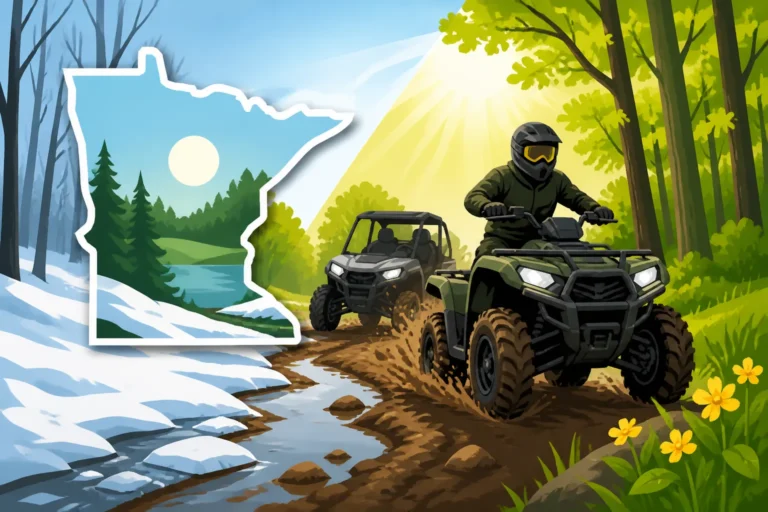
Minnesota trail conditions can shift with weather and seasonal restrictions. A route that was suitable during a dry period may become muddy, damaged, or closed after rain or spring thaw. Riding in poor conditions can harm trails and create a difficult experience for families, particularly when children are on smaller machines.
Check official trail status and local information close to your departure. Look for closures, construction notices, restrictions, and updates from the trail manager or maintaining organization. If conditions are uncertain, have a backup plan: a shorter route, another open area, or a different day. The drive to a trailhead is not a reason to ignore a closure once you arrive.
A navigation app can help you understand the route and keep track of your position, but it should not be treated as the final authority on access. onX Offroad can be useful for preparing a ride and viewing route information, while signs and current land-manager notices should guide decisions on the ground. Keep a paper map or saved offline information where practical, especially when cell service may be limited.
Pack for the ride you planned and the ride you might get
A good family packing list starts with the basics: properly fitting helmets and protective clothing, water, snacks, a first-aid kit, and a way to contact help. Add clothing layers for changing weather and supplies suited to the length of the ride. Kids can become cold or uncomfortable sooner than adults, and a small discomfort can quickly affect their concentration.
Bring what you need to handle minor, predictable problems without turning the machine into a storage bin. A basic tool kit, tire-repair supplies appropriate for your machine, and a way to secure loose equipment can help. If you are riding far from a staging area, plan more carefully for navigation, fuel, and communication. Tell someone who is not on the ride where you are going and when you expect to return.
Do a quick machine check before unloading and again before starting the ride. Confirm that tires, brakes, lights, and controls are in suitable condition, and make sure cargo cannot shift into a rider’s path. If a machine is acting strangely, do not count on it making it through a remote trail day. Fix the issue, arrange a different machine, or change the plan.
Make the outing comfortable and safer for everyone
Use a flexible pace and frequent regrouping
Families often worry that stopping too often will ruin the ride. In practice, short breaks can prevent the kind of fatigue that makes a ride miserable. Let riders drink water, adjust gloves, stretch, and check that helmets and protective gear still fit comfortably. A few planned pauses can be more efficient than pushing onward until someone is too tired to continue safely.
Keep the group visible and predictable. Avoid leaving long gaps between machines, and do not let a faster adult disappear ahead while a child is struggling behind. At intersections or confusing trail junctions, regroup and confirm the next direction before moving on. If you are using onX Offroad or another mapping tool, one adult should manage navigation rather than asking young riders to interpret a map while riding.
Choose stopping places with care. Pull fully off the riding line where it is safe to do so, and keep the group away from blind curves, steep approaches, and narrow sections. Make it clear that riders should not turn around or reverse suddenly without checking for others behind them.
Know when to shorten or end the ride
The best family ride is not always the one that reaches the farthest point. Turn back if a young rider is becoming tired, conditions are worsening, the group is behind schedule, or a machine is not behaving normally. It is easier to make that call when the group has agreed in advance that changing plans is a normal part of riding.
Pay attention to small changes in behavior. A child who stops talking, makes repeated mistakes, or struggles with basic controls may be tired or overwhelmed. An adult who is focused on getting through the route may miss those signals, so make room for riders to speak up without being teased or pressured.
If the route is busier or more difficult than expected, slow down and reassess. You may be able to choose a safer return route or stop at an appropriate staging point. Avoid riding beyond your group’s comfort just to complete a loop. A flexible plan protects the day from turning into a stressful one.
Treat the first trip as a learning ride
For a family’s first outing in a new area, make the main goal getting comfortable with the trail system rather than covering a specific distance. Learn how the trail is marked, how long it takes your group to travel, where breaks work best, and whether your machines are a good fit. Those details will make the next outing easier to plan.
After the ride, ask each rider what felt manageable and what did not. Children may be more forthcoming once they are off the machines and relaxed. Use their feedback to adjust the next trip: perhaps choose a shorter route, bring warmer layers, schedule more breaks, or use a different machine.
Families can also benefit from exploring local club and trail information before returning. Trail organizations may share practical information about access, maintenance, and local riding expectations. For planning ideas, see [Minnesota ATV Clubs and the Trails They Keep]. Then build your next ride around what your family actually enjoyed, not what you feel you were supposed to accomplish.
Disclaimer
This article is for general informational purposes only and does not constitute professional advice. Laws, prices and regulations vary by location and change over time. Consult a qualified professional for guidance on your specific situation.